It’s been four decades since I walked the streets of Kolkata during the Durga Pujas. But, in fact, I have returned to the city of my birth every year. Some years, I’ve even shown up twice or three times. And so I am inherently familiar with Kolkata. But it’s been some time and my brain is addled by this time warp, a condition that takes me backwards and forwards in time as I find myself recollecting the past while trying hard to not aggregate it with the present. My childhood friend, Kavita, is visiting from New Delhi and together with her sister, Pinky, we walk the bustling streets of Chorbagan (the garden of thieves) or Hathibagan (the garden of elephants), Tala (lake) or Shyam Bazaar (beautiful bazaar). The past seems palpably present, I can almost touch it and smell it. And the present looks very much in need of a retrospective gaze. I size up these neighborhoods: far from being beautiful elephant grounds or verdant pastures for thieves as their names imply, they are grimy, gritty, throbbing parts of North Kolkata—sections of town famous for their interpretive images of the goddess Durga.

I could write about what Durga Puja is. Who is Durga and why is she important to the Bengali imagination? What is the foundational basis for the worship of Durga? Who or what is a Bengali? How is Durga made from an artistic point of view? What is the cost of producing the 6,000 odd images that are housed in makeshift ‘pandals’ or pavilions choking an already overcrowded city? When is Durga Puja held? I could chat endlessly about any one of these topics or I could talk about the two Kolkatas—the one that the British ‘discovered’ in the 1680s and named Calcutta, that still maintains a certain colonial stronghold on the mental architecture of the city, or the one that is Instagram friendly, Taylor Swift loving, young and seemingly indestructible younger crowd. (At last count, 800 million of India’s population of 1.5 billion is under 30!). But I want to visit the Pujas in Kolkata today with my longest-standing friends and just take it all in.
A quick primer: Kolkata is the capital city; West Bengal is the name of the state where Kolkata serves as the capital, located on the eastern seaboard of India; Bengalis are culturally associated with the state of West Bengal; Bengali, Hindi and English are the primary languages spoken in this state.
It is 5 a.m. on October 22, the day of Maha Ashtami—the high point of the Pujas– and I look around with surprised recognition. At once things look familiar and not quite recognizable. We see throngs of people walking the streets. In this city of 16 million (in Kolkata proper), it is only natural to see such a sight, and, of course, with the Pujas, the population has presumably doubled if not tripled. But it is early and already the crowds are as thick as molasses. People all around me look glittery and dewy eyed. Their radiance only accentuates my unmade-bed look. My daughter, Priyanka, is running the Sacramento Ironman today, a world away, and I have been up all night, tracking her on the real-time feed that our son-in-law, Chris, has set up for us. But the ambiance of happiness all around me is infectious and it grounds me in the present. I see people looking hopeful and optimistic, holding on to a slender-ish faith in the future.

And this is when I realize that far from being a religious or even a spiritual practice, the worship of Durga—held over a ten-day period in India and in diasporic communities worldwide—is deeply personal and intimate. It is a celebration without any intercessors, marking the victory of good over evil, of us choosing our own angels in their death fight over our inner demons. Here in Kolkata, the intellectual center of India, the Pujas perform additional functions as well. They are social and celebratory, devotional and political all at once. This year, and because of the state of our world, issues of social relevance have become front and central in many interpretations. Where the central government appears to diminish the rights of women, the LGBTQ+ agenda, and those of other marginalized groups, the pujas bring on a full-hearted celebration of invisible themes existing in clear sight around us. What emerges is diverse belief heaped upon diverse belief that not even Narendra Modi’s politics can homogenize. In the end, the Pujas remain a highly artistic and creative endeavor, involving all sections of society. It is an and-and equation: social, political, artistic, consciousness-raising, and off-the-charts creative.
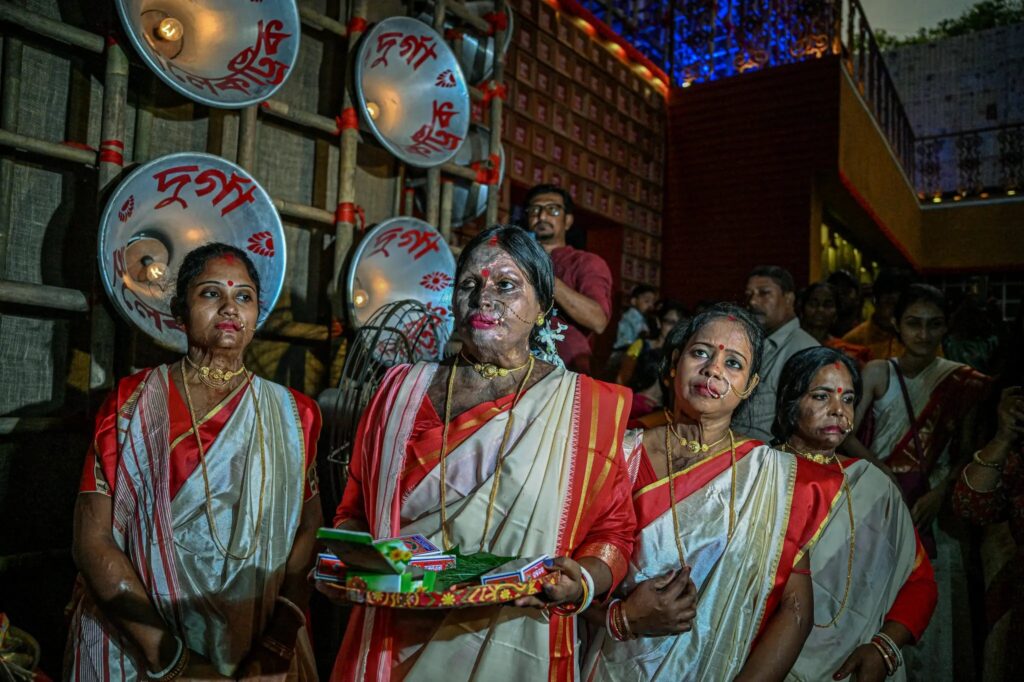
Durga Puja (in Eastern India, where I am originally from), Dussehra (in North and Western India), and Navratri (in Western and Southern India) are essentially one and the same celebration. In impact and importance, it is akin to the Super Bowl, the World Series, the Grand Slams, the Masters’, the FIFA Football Cup, the Grammys, and Oscars– all rolled into one. Durga Puja directly affects more than a billion and a half people in India alone, and many more in diasporic communities throughout the world. For its artistic merit and brilliance, the Durga Pujas were declared an UNESCO Intangible Cultural Heritage of Humanity Site in 2021.
The Pujas are also a welcome infusion of hard-core cash into the local economy. Many of the images and the ‘pandals’ in which they are housed run into millions of rupees. In the language of cold numbers, here are some statistics:
- 300,000 individuals are directly employed because of the Pujas in Kolkata, over a 6-month period every year, with many more experiencing an economic boost based on the industry. (The British Council, 2023, India)
- The Durga Puja is worth 7% of West Bengal’s total annual GDP. (The British Council, 2023, India).
Today I see the enormous range of human differences which are embedded in similarities. At the Mohammed Ali Park Durga Puja, which is located opposite a fully functional mosque, the Islamic afternoon prayer or azaan blares plaintively over loudspeakers. Meanwhile, the Durga pavilion simulates the Hindu Somnath, one of the holiest of Shiva Temples in Gujarat. The figures are Kehinde Wiley like, in their baroque robes and dramatic gestures. The Telegraph reports that in multiple puja pavilions like this one, Muslim community workers put the finishing touches to the Durga image while their Hindu assistants lend a hand. Mohammed Syed of the Mominpur Tarun Sangha, has been doing this for the last 20 years with his Hindu assistant, Satinath Adhya. The Telegraph reported that “Inclusiveness is ingrained in Indian culture. But the past decade has witnessed a full-fledged attack on this culture. That is why it is vitally important that we should preserve it.” Adhya’s sentiments are echoed in different parts of the city. (The TelegraphOctober 20, 2023).

The story of Durga itself speaks to this truth: that what is unlikely ends up becoming the norm, that what we sometimes imagine can become our reality. The story itself is Joseph Campbellian, of epic proportions, where the goodness of Durga vanquishes even the thought of evil.
As consort of Shiva, the head honcho in the Hindu pantheon, Durga is a force to be reckoned with. She is the Goddess figure and endowed with special powers, she confronts the demon, Mahishasura, often represented in the form of a buffalo. Evil, she observes (famously in Birendra Krishna Bhadra’s epic poem, Mahishasura Mardini), is chameleon like—it is often pleasing but its form is mercurial, almost enticing. In other words, while goodness is always available to us, in its predictability it becomes almost pedestrian and unexciting. Evil, on the other hand, tends to be exhilarating, changing likeness and keeping us sufficiently involved and herein lies its allure and magnetic pull over ordinary mortals.

But Durga knows the story line. Mounted on her lion, she pursues the buffalo demon and cuts through its skin. As the blood oozes, the demon can no longer contain its camouflage. This is the cue for Evil to reveal itself; he must out and this he does. In this way, we are rendered an annual homily, a continuous revelation– that goodness and evil can (and does) dwell in equal measure within and among us. The struggle is always painful, giving way to the clarity that it is only through the power of goodness that we can attain understanding and peace. A simple choice—that of loving our neighbor– allows us the bandwidth to become better than who we are, giving us a more expansive way of living with ourselves.
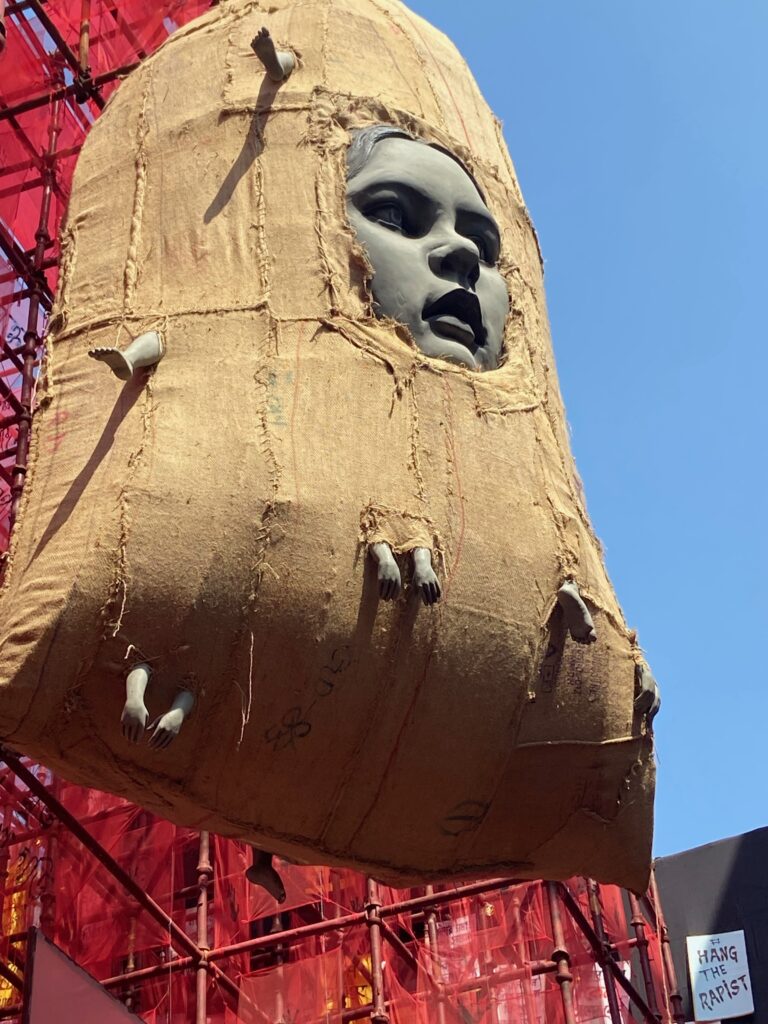
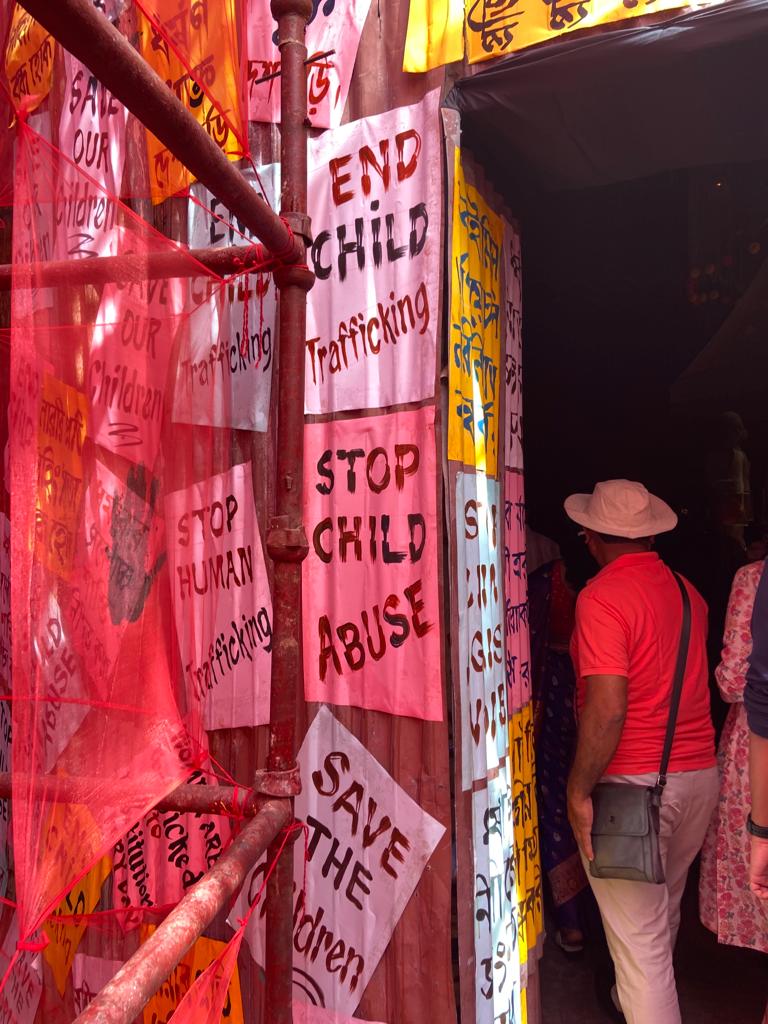
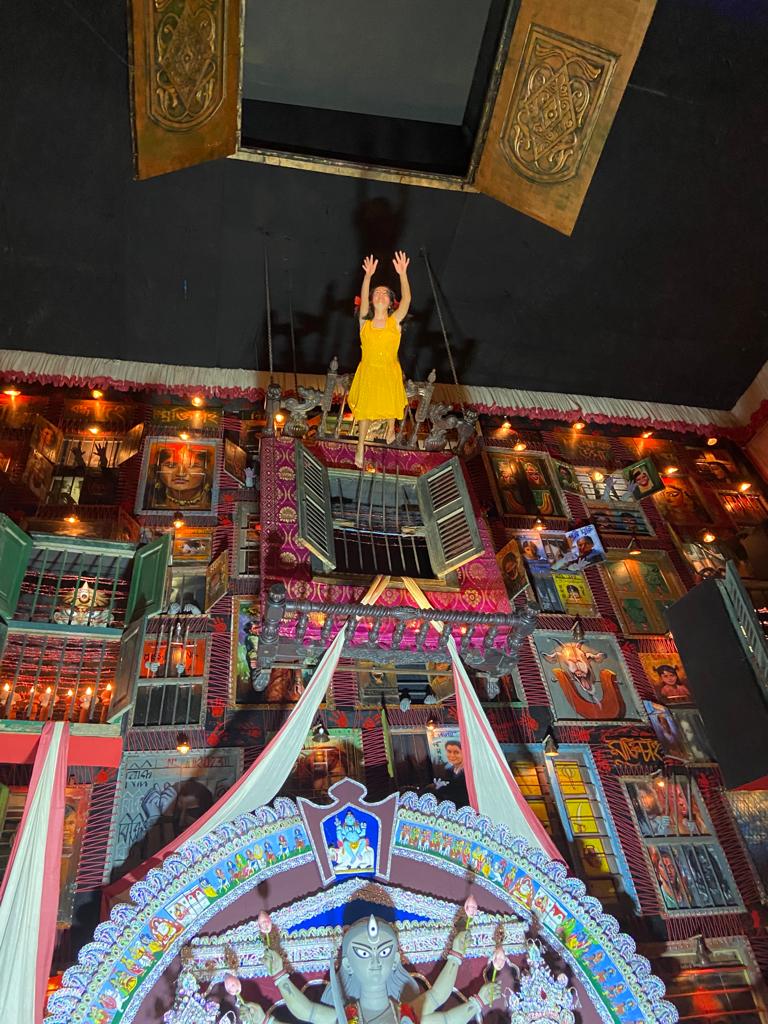
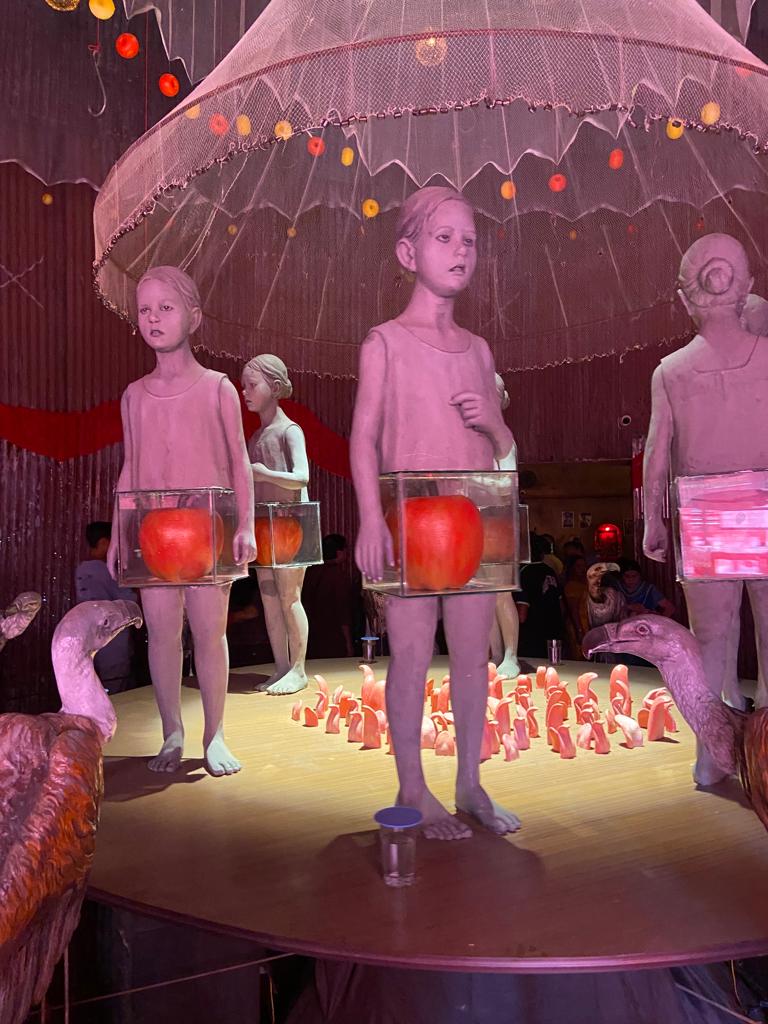
The Durga story continues to captivate the public imagination. Of the 6000 neighborhood pandals or pavilions set up for worship, the one in Kashi Bose Lane is particularly thought provoking. A young child is trapped in a giant sandbag in a contemporary installation. Later, in the various rooms leading to the Durga, young children are paraded on a rotating lazy susan. They are violated by vultures who are seated at the table. Atop Durga, a young child, trapped in a bed, jumps to her death. Everywhere, posters of trafficked children line the pavilion including protest signs urging Death to Rapists and Save our Children as pathways to action. The effect is at once a bone-chilling reminder of the social injustices that exist all around us and a call to action.
Ultimately, Durga comes to us as an annual reminder of our own power to be good, to do good. By the time that the Pujas are over, she’s left behind communal harmony, an awareness of the injustices surrounding us, economic prosperity, and artistic masterpieces. What more could anybody desire from a single festive holiday where a lone mother is celebrated for her tough love as well as her ability to inspire change on an annual basis.
Wow, this is something to behold! Thank you for the thorough education on something I know so little about. How amazing to experience it, over and over.
I miss you, Nancy. Thank you for your affirmation….