A Heat That Holds History
It is 103 degrees in the shade, and we are doing our best to look as though we belong here. Siem Reap, the golden heart of Cambodia, is steeped in the spoils and sorrows of history. This UNESCO jewel literally means “Siem Defeated,” a reference to the Khmer sacking of the great Thai city of Ayutthaya in the 17th century. Situated at the crossroads of the Siem Reap River and the Tonle Sap Lake, the region lay lost to jungle and time for centuries. Though Portuguese and Chinese travelers stumbled upon Angkor in the 1500s, it was only in 1907 that French explorers “officially” rediscovered this hidden sanctuary. The rest, as they say, is history.

From Modest Village to Cultural Mecca

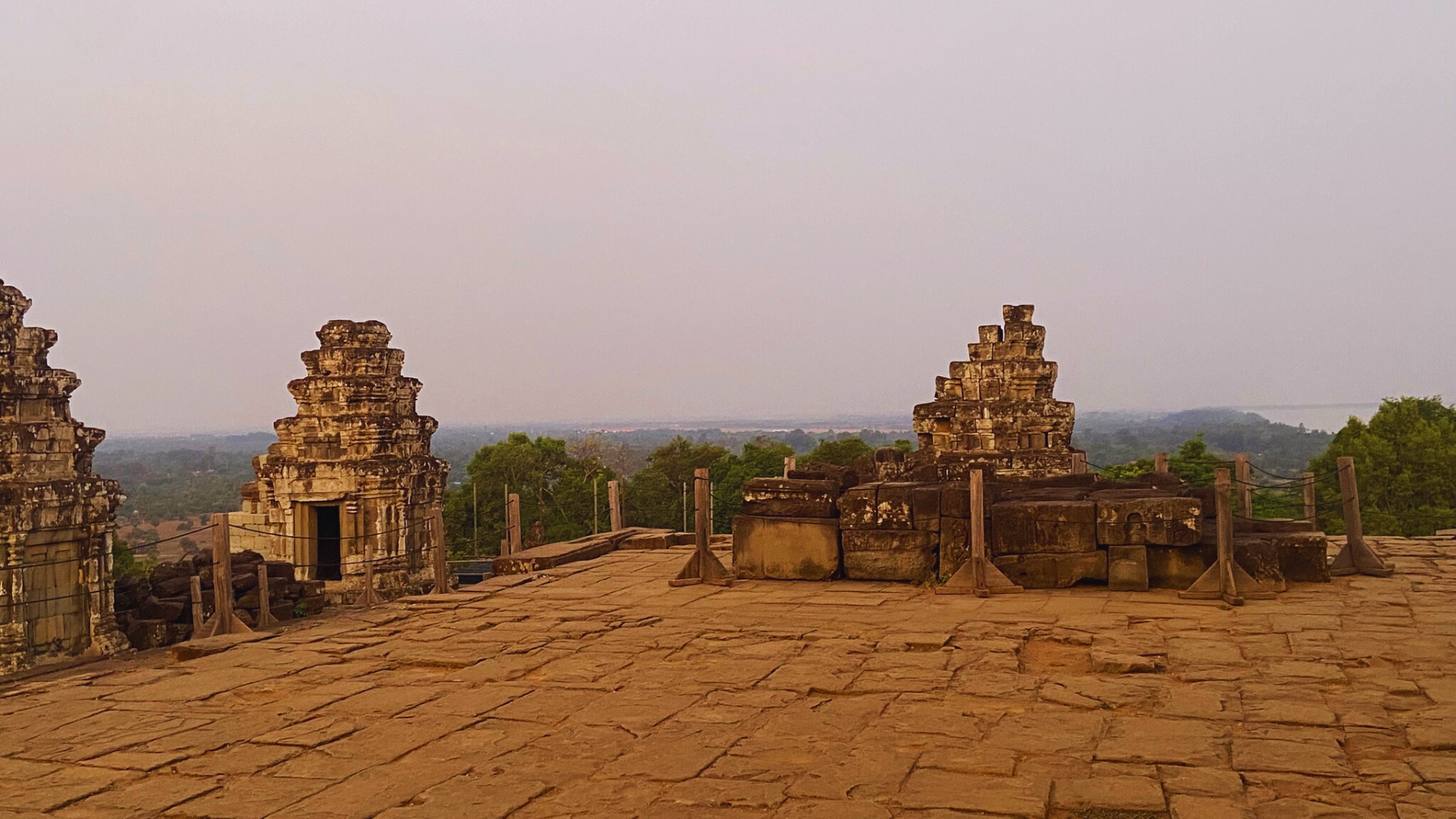
What began as a small village en route to the Mekong Delta has grown into Cambodia’s second-largest city, drawing over 13 million visitors in 2018—up from zero during the Pol Pot era and the COVID years. Today, Siem Reap is synonymous with cultural heritage. The vast Hindu-Buddhist temple complex of Angkor has placed Cambodia firmly on the global map. Angkor Wat and Angkor Thom—along with Phnom Bakheng, Baphuon, and Bayon—are its crown jewels. So central are these temples to Cambodian identity that Angkor Wat appears on the national flag, its five towers instantly recognizable.
A Realm of Seventy-Two Sanctuaries
But Angkor is far more than its most famous monuments. The region includes seventy-two distinct temple complexes that rise from the misty jungle like ancient beasts stirring awake. Angkor Wat, with more than a thousand buildings, is the most renowned. Angkor Thom follows closely—its sprawl resembling a cinematic dreamscape, more Indiana Jones than devotional shrine.


Temples rise like creatures waking from centuries of sleep.
Meeting Ry: A Guide Shaped by History
Our guide, Ry (pronounced “Ree”), tells us that Angkor was the Khmer Empire’s capital from the 9th to the 15th centuries—a Renaissance period marked by flourishing arts, expanding cities, and relative peace. Between 1010 and 1220, Ry explains, Angkor supported at least 0.1% of the world’s population.

Ry has turned to monkhood three times. Now nearly sixty-five, he plans to return again. I feel a jolt of recognition when I see him—he reminds me of my late father-in-law. Both men are grounded yet spiritually driven, modest but limitless in their approach to life. Ry’s broad face seems to span continents; his thin jaw juts forward like a geographical isthmus. His high cheekbones and generous forehead appear carved by time itself.
But beneath these striking features lies a life marked by profound hardship. Robbed of his innocence by the Khmer Rouge, he witnessed his grandmother’s execution and endured torture himself. His voice trembles—not with resentment, but with compassion. He has forgiven his enemies, he says. His goal now is to help Cambodians heal their invisible wounds.
Ry carries his scars like quiet lanterns.
Forgiveness is his true temple.
A Spiritual Tapestry
Ry explains that Cambodia follows Theravāda Buddhism, which focuses on the teachings of the Buddha. Mahāyāna Buddhism—as practiced in India—regards the Buddha as divine, much like the Dalai Lama. As I begin to understand this distinction, the temples reveal their layered spiritual DNA to me. Theravāda introspection sits side by side with Mahāyāna devotion, both emerging from a Hindu foundation.
Angkor Wat: Monument of Monuments
Built in 1150 during the reign of Suryavarman II, Angkor Wat is the world’s largest religious monument. Originally dedicated to Vishnu, it later became a Buddhist shrine. Jayavarman II founded the Angkor kingdom in the 9th century, but it was Suryavarman II who envisioned and commissioned Angkor Wat—completed astonishingly in just thirty-five years.
As I move through the vast complex and witness miles of wall reliefs and steles, a quietness settles in. There is nothing to understand now, I tell myself. That will come later. For the moment, it is enough to experience this jungle mystery and imagine its vast incarnations.
A King Beneath the Spire
More than a temple, Angkor Wat was also the king’s mausoleum. Suryavarman’s remains were buried ninety-two feet beneath the central spire, entombed with jewels later looted during French excavation. Though the treasures are lost, his body was eventually returned to Cambodia. Unlike other Angkor temples—either shrines or monasteries—Angkor Wat is also a tomb. And it contains the remains of a king who died nearly a thousand years ago.
Symbols in Stone
During our day-long excursion, Ry shares his insights with meticulous care. Unique among Angkor’s structures is that Angkor Wat faces westward. Scholars suggest this orientation reflects its funerary function, with the west symbolizing death and the setting sun—though this remains debated.

Others say the temple represents Mt. Meru, mythical home of the Hindu gods. Its five towers represent Meru’s peaks; the surrounding walls and moat signify encircling mountain ranges and the cosmic ocean. Some believe its layout encodes Hindu epochs or functions as a celestial calendar—the central spire aligning with the rising sun on the spring equinox.
Angkor Wat is a calendar written in sunlight.
Architecture as Cosmic Blueprint
Architecturally, Angkor Wat blends the temple-mountain design typical of Khmer state temples with the galleried corridors of Hindu sanctuaries. The temple-mountain structure is self-evident as the building rises like a massif from the jungle. The galleried corridors narrate epic stories in stone—gods and demons, battles and ascensions—laying out the moral code of Khmer civilization. These walls are a kind of ancient Kindle: a linear, chronological reader of myth and ethics.
Ry points out the distinct carvings: the flat faces and elongated earlobes of the Khmer people, contrasted with the coarser features of the Champa of West Vietnam—depicted as asuras, or demons. The bas-reliefs swirl counterclockwise through celestial and human struggles—epic, eternal, archetypal.

Three Levels to Heaven
Angkor Wat’s three tiers symbolize heaven, purgatory, and hell, with access carefully stratified. Only the elite reached the third level—the inner sanctum. Construction used sandstone blocks joined in tongue-and-groove fashion. Ingeniously, the builders harnessed the water table to stabilize the immense structure.
Angkor Thom: The City of Souls
If Angkor Wat is the spiritual heart of the Khmer empire, Angkor Thom is its soul. A walled city suspended in time, its temples collapse into beautiful ruin. Roots spill over stone like fingers of time reclaiming their due.
I think of Shelley’s Ozymandias:
I met a traveller from an antique land,
Who said—“Two vast and trunkless legs of stone
Stand in the desert. . . . Near them, on the sand,
Half sunk a shattered visage lies, whose frown,
And wrinkled lip, and sneer of cold command,
Tell that its sculptor well those passions read
Which yet survive, stamped on these lifeless things,
The hand that mocked them, and the heart that fed;
And on the pedestal, these words appear:
My name is Ozymandias, King of Kings;
Look on my Works, ye Mighty, and despair!"
Nothing beside remains. Round the decay
Of that colossal Wreck, boundless and bare
The lone and level sands stretch far away.
Source: Shelley’s Poetry and Prose (1977)
The monuments crumble, but their ambition remains undiminished. Unlike Angkor Wat, Angkor Thom has been left largely untouched. Trees erupt from temples. Doorways yield to jungle. Built in the 12th and 13th centuries, the city includes Baphuon, the Terrace of the Elephants, and the Terrace of the Leper King.
At the South Gate, Jayavarman VII’s face appears over and over—serene, watchful, eternal. Along the bridge, gods and demons churn the Sea of Milk, the Hindu myth of creation carved in sandstone. Bayon, Jayavarman VII’s state temple, stands at the city’s core—a Buddhist sanctum layered atop a Hindu foundation. Emerging from the jungle mist, it becomes, as scholar Paul Wheatley wrote, “an astronomical calendar in stone.”
Abandonment and Afterlife
After 1295, construction in Angkor Thom ceased. By 1609, the city was abandoned. At its peak, more than 150,000 people lived within its walls.
Time, Memory, and the Rise and Fall of Civilizations
Time binds us all—to beginnings, to endings, to what lies in between. These temples rise, fall, and rise again—like memory, like myth, like the breath between lifetimes. Angkor Thom is a reminder of all of this.