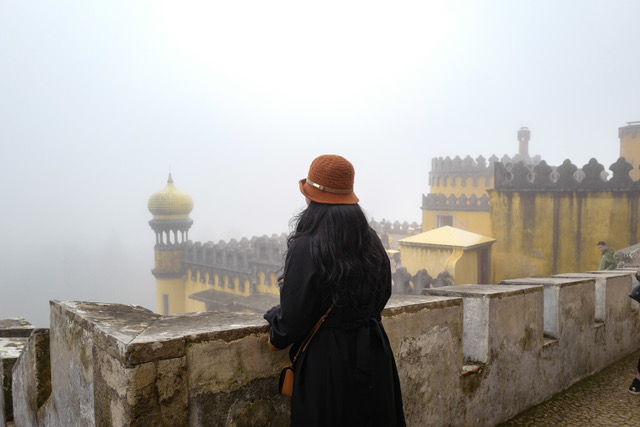
Sintra in the cold of February appears more mysterious than ever. For one, this regal town in the hills of Portugal sits apart from low-lying Lisbon. And being perched on an elevation means that it is at least ten degrees cooler and perpetually shrouded by a thick mist that turns into a steady haze as the day gets older. Here, nothing is as it seems. Everything is layered with insinuation, real or imagined. At least, this is our general sense as we consciously stumble onto the road less traveled.
The Palace of Sintra, the best-preserved medieval royal residence in Portugal, is the one UNESCO site that most people tend to visit. Indeed, we ourselves have done so in a former time: this shiny palace atop a hill that was continuously used from the early 15th to the late 19th century. Originally built in the Moorish tradition as part of the Umayyad conquest of Hispania, over the centuries it became a wedding cake of sorts, layered with components of the Gothic, Manueline, Moorish and Mudejar traditions.


Photos courtesy of Amy Karlen
We skip the glossy palace with its bejeweled chapel and rooms decorated with multicolored azulejo tiles from Seville. Instead, we walk up a short incline to the Pena Palace, a complex of mystery that was rebuilt by a maverick for a maverick.

Photo courtesy of Amy Karlen
Quinta da Regalaira is a UNESCO designated 10-acre manor house in the heart of Sintra that most people overlook. Although the overall structure is older, Quinta del Regulaira as it stands today was built in the late 1800s as a reflection of the cultural, philosophical and scientific interests of its principal owner, Augusto de Carvallao Monteiro (1848-1920), who together with the Italian architect and set designer, Luigi Manini (1848-1936), created whimsical, eccentric, and curious architectural modifications that border on the magical.

Like a wedding cake, layer upon layer of the patron and the architect’s deepest desires are piled one on top of the other. The result is an eclectic integration of the Manueline, Renaissance, Medieval, and Classical. And added to this goulash are the enigmas specific to alchemy, the Free Masons, the Knights Templar and the Rosicrucians. When Monteiro’s Quinta was completed in 1910, it provided flashes of insight into the specific knowledge of these mysterious and secretive societies. Monteiro reveled in the symbols that were created in his Quinta–all reflecting his own interests and ideology. With his death in 1920, he had but a short period during which to enjoy the Quinta de Regalaira.

Quinta da Regaleira had many owners over the years. It’s provenance can be traced to a family of wealthy merchants from Porto when it was sold to Monteiro in 1892. The estate changed hands after Monteiro’s death– first to Waldemar d’Orey and then to the Aoki Corporation of Japan. In 1997, the Sintra Town Council acquired the property and in 1998, it was opened to the public, designated by the Portuguese Ministry of Culture as a “public interest property.”
The Quinta’s principal owner, Carvalho Monteiro, was a bibliophile, an entomologist, a botanist specializing in Brazilian and Indian plants species, a fluent speaker of Latin who possessed a unique collection of books by the poet, Camoes. He was a man of refined taste and, simultaneously, a devout Catholic, a royalist, and a Free Mason.
His father had made a fortune in the trade of precious stones, and Monteiro put the funds to good use by creating a magical kingdom, a fairy tale into which one could enter and forget about the cares of the world. His interests were wide ranging– as one of the founders of the Lisbon Zoo, and a vigorous supporter of the Misericordia de Sintra and the Royal Theater of San Carlo.
Monteiro was cultivated beyond the ordinary and he seems to have met his match in his architect and landscape designer, Luigi Manini. When Monteiro conspired to create a palace complex with a tower, an initiation well, a grotto, and secret tunnels through waterfalls–Manini was the one who gave form and substance to his ideas.
Entering the gardens, we sense the presence of ghosts right away, spirits who roam this place freely and give proof of their existence if we look closely enough. We walk past turreted ramparts and vertical towers that seem to go nowhere. Somehow, we sense that we are in a movie set such as Nosferatu or Dracula
The Palace

The bright yellow exterior of the Quinta brings to mind the era of the Sun-kings and of resurrection itself. In the Quinta’s palace, yellow is a stand-in for nobility and the clergy–referencing the wealth and power of the social class that used this property. Kings and Queens lived here, away from the pestilence and heat of Lisbon. They came here in the summer as a form of escape and in some cases, they stayed for the magic. The palace contains five floors (a ground floor, three upper floors, and a basement). The second floor contains Carvalho Monteiro’s vast office.

The Manueline tiles–the yellows and ochres and greens of the 16th and 17th centuries, and the blues from the 18th century– help us keep our history of azulejos in honest categories. We wander the cloisters, a Manueline monastery of the 16th century in Hispanic-Mooresque tiles.

The Office of King Charles provides an intimate portrait of a monarch who was also human. We see irreverent doodles by the King himself, of nymphs and satyrs in the park creating havoc with their sexual shenanigans. We wander through Charles’ bedroom, and stop to see a niche in the wall that is entrusted with small stones, shell, and porcelain fragments. A young man’s findings on an otherwise unremarkable day. The mahogany and hard wood furniture hails from trees in Brazil and India, Portuguese colonies both, while the workmanship speak to the craftsmanship of Lisbon bespoke carpenters.


Photos courtesy of Amy Karlen.
The Park

Much of the 10 acres of land in the surrounding estate consists of a densely treed park. The woods are neatly arranged in the lower parts of the estate but are left wild in the upper parts. The park also contains an extensive and enigmatic system of tunnels which have multiple entry points that include grottoes, the chapel, Waterfall Lake, and “Leda’s Cave,” which lies beneath the Regaleira Tower.
Bodies of water can be found in several places in the park. Two artificial lakes and several fountains were added by Monteiro. One of the most interesting and extravagant among them is the Aquarium, built as if it were naturally embedded in a large boulder. Exuberant Gothic pinnacles, gargoyles, and capitols line the exterior.

The Chapel
The Regaleira Chapel is Roman Catholic, its interior richly decorated with frescoes of St. Teresa of Avila and St. Anthony alongside stained glass windows. The floor offers depictions of Portuguese discoveries and the Order of Christ’s Cross, surrounded by pentagrams.

Initiation Wells
The Initiation Wells (also called initiatic wells or inverted towers) are two wells that better resemble underground towers lined with stairs. These wells never served as water sources. Instead, they were purportedly used for ceremonial purposes.


Of the two wells, the larger one contains a steep spiral staircase. The nine flights of stairs could be linked to the Knight’s Templar, which had nine founders. They might also symbolize the 9 levels of Hell from Dantes’ Inferno. At the bottom of the well is an inlaid stone compass with the Templar cross.
Carvalho Monteiro was possibly an initiate of the Knights Templar, a Catholic military order. This medieval order originated in the early 1100’s and likely disbanded in the 1300’s. However, groups like the Freemasons revived their rituals and traditions hundreds of years later. It is believed that initiations at Quinta da Regalaira began with blindfolded candidates entering one of the wells. They purportedly held a sword close to their heart and descended the 9 flights of stairs. Once they reached the bottom of the well, they walked into a dark labyrinth and needed to find their way to the chapel, where they were welcomed into the brotherhood.

The Quinta da Regalaira mystifies and delights at the same time. Where else will you climb a few flights of stairs to see that you are not going anywhere….