Arrival at the Sofitel Legend Metropole
It is late Spring as we step into the Sofitel Legend Metropole in Hanoi—an opulent hotel whose foundations predate its 1901 opening. Nestled in the heart of the French Quarter, it brims with high-end Parisian culture on one hand and the chaos and cacophony of Vietnamese life on the other. These are the contradictions that are inherent in my close reading of Vietnam in the weeks that I have been here. And it is one of many that informs Vietnamese life and culture as I see it.


Historical Foundations
The hotel was founded by French investors Gustave-Emile Dumoutier and André Ducamp in the 1920s as the largest hotel in Indochina. It flourished for many peaceful decades till the call of the Viet Minh uprisings in the North and the Viet Cong forces in the South demanded attention. Driven by the devastating American War—as the Vietnam War is known in these parts—the Metropole was shuttered to the world. In the 1960s, it served as Embassy House—a refuge for eleven embassies and three UN agencies. In the 1990s, after an extensive renovation, the Sofitel Legend Metropole Ha Noi’s storied legacy became public all over again.
While the historical record is not as important for the passerby, turmoil-saturated though it may be, it is important to know it all the same. This is because the story of this magnificent belle dame is closely intertwined with that of the nation: a mixed bag of beauty mixed with the horrors of unrelenting war.
Contradictions Behind the Scenes
A gorgeous neoclassical Parisian hideout where guests sip Angeline’s famous martinis—balanced to perfection—there are worlds of contradictions working behind the scenes at the Sofitel. At once, the local indulgence affectionately dubbed the Pornstar Martini exists alongside international tight-lipped meet-ups among black suits: the likes of Donald Trump and Kim Jong Un’s extensive support system.
Ephemeral pleasure that is aesthetically perfected exists side by side armies of floating dark suits.

Pornstar Martinis are served in long-stemmed glasses that recall dangerously teetering heels. It is a perfect blend of Tito’s vodka infused with vanilla, passion fruit, Grand Marnier, and topped with a champagne cloud.
History and National Context
We quickly discover that visuals are not the ultimate arbiters of truth; they merely suggest it. Our University-trained guide, Soh, tells us that the country fought the French for over 200 years, achieving independence only in 1975. More recently, it endured the American War in the 1970s and a brief war with China in the 1980s.
Fresh-faced Soh walks us through the ledger of marauders: the French, the Belgians, the English, the Viet Minh in the North, the Americans, the Chinese, the Russians.
Vietnam was repeatedly carved up by a surgeon’s scalpel into sorry pieces occupying the land between India and China.
It was depleted to the point of extinction over and over again. And yet, the country held its ground—mutilated but alive. With the exception of the Sofitel Metropole, most of Hanoi is only about 50 years old—radiating youth, energy, and urgent momentum. The city also reflects a certain sense of tedium in the sameness of bland government buildings or miles and miles of housing that is meant solely for the purpose of existence.
The Sofitel Staff: Observers and Symbols
In the story that I see unfold, Berthe Morisot’s young Parisian women gazing into the public world becomes recognizable in the Sofitel housemaids. In their floppy white bonnets and flawless complexions, the Sofitel housemaids reflect insouciance or even a certain Parisian disaffection. They are the eyes of the hotel as they look around and away.

Similarly, the bellboys play a critical role as observers. They look regal in their red velvet jackets, resembling characters in an Amor Towles novel…the eyes and ears of Vietnam.
Yet, the Metropole stands as an important gateway of public memory. It is the place where the news is made and recorded after important meetings. Live TV is created here—for instance, when Trump met up with Kim Jong-Un in these sanctified spaces. Overall, the hotel serves as the instrument of the national conversation. From world figures to cardinals and rock stars, all seem to conduct their affairs from the vicinity of these storied rooms.
And one begins to sense the hidden truths lying in clear sight: that in a communist country like Vietnam, one does have limitless choices. But the path to an actionable outcome are few and flawed in between.

Vietnam: Entrepreneurial and Communal
“Vietnam reveals itself as both ambitious and humble, individualistic yet deeply tied to community.”
The entrepreneurial spirit, says our guide, is a lingering gift from the French colonists. Yet even today, Ho Chi Minh’s Confucian values remain firmly rooted in public life. Family and community are important as is evident in the crowded sidewalks that transform into al fresco restaurants at nightfall.
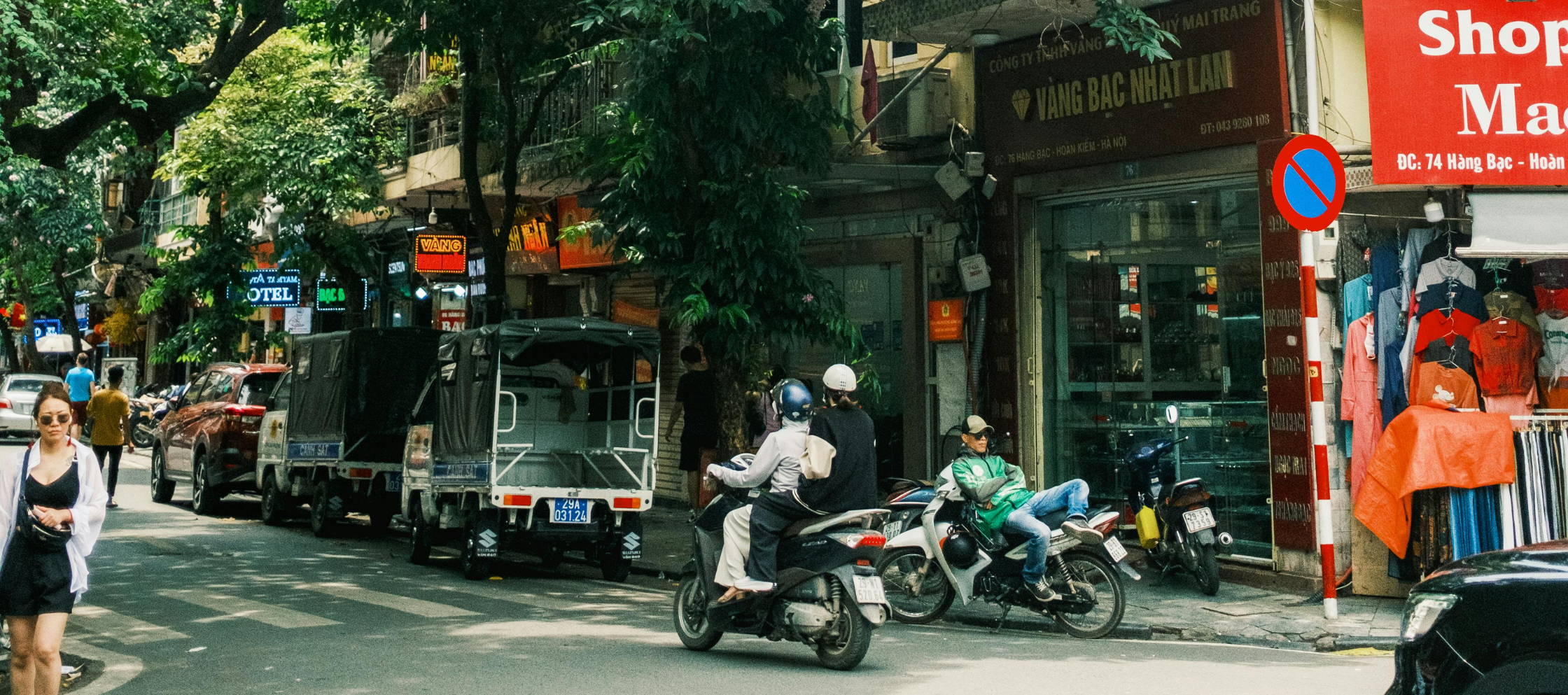
While Vietnamese cuisine is infused with style and variety, most people—New York City style—prefer to eat at mom-and-pop diners every evening. I also notice that alongside 100 million people, Vietnam also holds 80 million motorbikes. These roar through the broad avenues at any hour. Entire families ride in tandem—babies in arms, groceries and livestock in the back—destiny must be fulfilled and there is not a moment to be wasted. Capitalism, not communism, drives the momentum and the Vietnamese family unit is all in.
“Ambition here is fueled not by ideology, but by family networks and relentless drive.”

The French Quarter and Night Markets
The French Quarter—past the Philippe Patek and Louis Vuitton shopfronts—gives way to broad avenues that become pedestrian-only thoroughfares on weekends. Everything is in place, both the language of the empire and that of the vernacular—a culture of the street and that alongside the street.
In the night market, the dense mass of human diorama shape-shifts between the Western and Eastern dialectic. An ancient palm reader with a gnarly beard locks eyes with wary passersby. He waxes eloquent on Jupiter’s ingress into Venus and its transition through Cancer. Little electric carts buzz in agreement.


Monuments and Memory
Two monuments in Hà Nội bring home this contradiction. One is Ho Chi Minh’s Mausoleum, a paean to the father of modern Vietnam who founded the Democratic Republic of Vietnam and became her first President. A man of letters and of art, he is lovingly remembered as “Uncle Ho.” In fact, children are schooled on the alphabet through stories of this avuncular figure.
“Ho Chi Minh endures as a symbol of humility and connection—an everyday hero elevated to national legend.”
Everything about Ho Chi Minh speaks to his relatability and salt-of-the-earth bearing. Yet, his mausoleum is anything but that. Covering an entire city block, the mausoleum resembles a Greek temple perched on a raised platform in the center of Ba Đình Square. On closer inspection, Vietnamese architectural elements become clear—the iconic sloping roof and somber grey granite exterior to set the mood.


The complex is guarded by four cadres of military guards distinguishable by uniform. Phones off, hats removed, we let the silence of the granite envelop us.
At the center lies Ho Chi Minh’s frail body—his skin alabaster under the spotlight, his hair a surreal orange from embalming agents. Since his death in 1969, President Ho has had a busy traveling schedule, going to Moscow for his annual preservative treatments. After 2013, the specialists came to Hà Nội instead. Only recently, it seems, has General Ho been gifted the promise of eternal rest.
Hỏa Lò Prison: A Fiery Furnace
The second site that haunts me is Hỏa Lò Prison, which translates to “fiery furnace.” Built by the French to hold political prisoners, it was later used by North Vietnam to detain American POWs during the American War. Famously known among U.S. servicemen as the “Hanoi Hilton,” it once held Senator John McCain, who recounted his experience in Hoa Lo in his memoir, Faith of My Fathers.
Hỏa Lò was originally a school, a site of learning. But over time, it became a symbol of colonial brutality. Built for 600 inmates, it held as many as 2,000 prisoners in the 1950s. Today, only a small corner remains as a museum; the rest was demolished in the 1990s. Serving as an instrument of torture, the prison became too painful of a reminder of its brutal past. That’s why, it had to go.


Torture methods inside the system included rope bindings, beatings, and prolonged solitary confinement. We see the infamous cachots—dark dungeon-like spaces where prisoners were shackled, forced to eat, and relieve themselves in the same spot. Their bodies bloated with edema, their skin raw from scabies, they died of terrible infections that in another time, would have been curable. Hoa Lo also displays single- and double-log shackles, guillotines, and sewer lines once believed impassable. Yet seven prisoners escaped through them, defying the odds. In the nearby courtyard, stands the bang tree—a modest species that bore witness to it all and provided hope for so many. Its fruit offered a rare salve to those who dared to dream of survival. The bang tree provided a ray of hope for the few that survived this camp, Viktor Frankl style.
Reflection
As we leave Hỏa Lò, the echoes of past injustice still vibrating in our minds, the bright façade of the Metropole comes into view.
“In Hà Nội, history breathes through every street—unburied, unforgotten, and completely alive.”
A mixed bag of the beauty of the human soul intertwined with the horrors of unrelenting war.