The idea of home has always held special meaning for me. Ungrounded at an abysmally early age by the unexpected death of my father, I became rootless by temperament. I came to identify myself with wanderings, a certain discontentment, a specific directionless travel plan that took me from here to there but seemingly nowhere where I wanted to be. Or somewhere that was meaningless to me once I got there. I became a professional asker of questions, someone who had more of them than answers. For instance, for the longest time, I grappled with the question, why—why was I doing what I was doing? Scaling mountains? Reading Simone de Beauvoir? Getting my Ph.D. in British Lit? Watching people wait for the bus? There seemed to be no prioritizing in my relentless questioning. What held meaning for me? What was meaningless to me? It was apparent that settling down would take the better part of my life and indeed it did. In fact, it took me several decades to come to terms with myself. Perhaps, even love myself for who I was. And that’s why the concept of home became a setting so profound that at once it symbolized a womb into which I could crawl and a porthole through which I could scan big dreams in the larger world. Home was a place where I could be myself, separate from my perpetual restlessness. My bed marked an architectural landscape that allowed for vertical uplift, grounding and releasing me simultaneously. Home, my home, created with decades of intentional care, held this special place for me: meticulously diagrammed but spontaneously free ranging all at the same time.

These thoughts lingered on my mind as I traveled down Avenida Antonio Lopez de Bello in downtown Santiago, Chile, to visit the home of Pablo Neruda. I had read his highly emotional slash erotic poems in high school and college, and many decades later, our friend, Ale, gifted me one of his books of love poems. When you learn to read Spanish, she had said, perhaps you will read the book and enjoy it as much as I do. I remembered Ale’s confidence in my abilities, the sheer force of her will in believing that one day I would be able to read Pablo Neruda in Spanish. And that’s why, even after moving homes three times in as many decades, I still hung on to the slender volume with the green cover. All I wanted to do today was to reconcile my impressions of Neruda—of how he presented himself versus how he really was. It made me think of how we construct a narrative of a person based on the coordinates of our own life—and it is this version of reality that we hold onto versus the thing that presents itself to us. For this reason alone, I love visiting the homes of artists, writers, and thinkers. Parsing through a curated home uncovers for me what the person was really like, how they spent their days, what ideas mattered most to them.
These ideas jostled in my head as we cut through the ruthless heat of a Santiago January afternoon. It was the height of summer and the sun bore through my thin cotton shirt and bleached it clean. I stopped to stare at two Santiago traffic police. It was north of 90 degrees, but these two looked like overstuffed penguins in their thick white shirts, skin-tight breeches, and sturdy waistcoats. Somehow, their clothes sat easily on the outer edges of their skin. This afternoon, the traffic cops, perhaps simmering with an inner rage, were writing up tickets—in a street of 10 parked cars, just two escaped their fancy. I was fascinated by their choice-making: what led to their decision? Why the brutality?
Past a trendy café at the corner, we turned into a quiet street that led to Neruda’s home. An industrial steel gate led into the complex. Pointing the way from the outside were two walls of murals that reminded me of Marc Chagall—at once funny, wistful, mystical, serious, lighthearted.

La Chascona, or the one with the wild hair, was the house that Neruda built for his secret lover, Matilde Urrutia, who eventually became his third wife. They met in Mexico in 1949—she was a Chilean singer who was hired to take care of him when he came down with phlebitis. He was still married at the time but he quietly built this house for their secret love. This is where she lived until they married in 1953. Eventually, La Chascona became a home for both of them —one where Neruda could manifest his various selves and learn to live with his numerous legacies. In this unlikely nest, Neruda was able to integrate his artistic and creative life with his radical politics and diplomatic work.
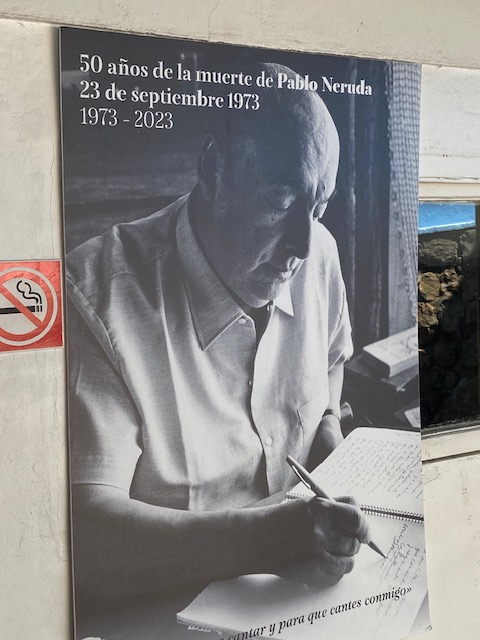
As a refresher, Neruda was a Chilean poet, politician and diplomat who won the Nobel Prize in Literature in 1971. Born in 1904, his mother died when he was just 2 months old and one can sense that abandonment, the aching nostalgia surrounding a permanent loss. Neruda became a poet at age 13 and wrote in a wide variety of genres: surrealist poems, epics, political manifestos, an autobiography, and passionate love poems, such as Twenty Love Poems and a Song of Despair(1924). What surprised his readers was the intensity and graphic details of his erotic poems written while he was still in his teens.

Neruda occupied many diplomatic positions in Myanmar, Sri Lanka, Indonesia, Singapore, Spain and Argentina and served as a senator for the Chilean Communist Party. He consorted with Lenin, Mao Tse Tung, Stalin, and Castro, and was forced to walk back his views when he witnessed the debilitating effects of communism and dictatorship. He continued to create prolifically during his diplomatic career, addressing in his writing the hardship and brutal living conditions of exploited farm workers in Chile. He never stopped fighting for the commoner and for Chile’s “collective obligation.”

In terms of his personal life, Neruda married a Dutch bank employee, Maruca Hagenaar, in Indonesia, and had his only child, Maria Malva Reyes, who was born with hydrocephalus and lived to be only 9. He abandoned both when he met his second wife, thus reducing his first family to a life of poverty. From these details, I could surmise that Neruda was expert at running from the present into the future. It seemed that he was also adept at compartmentalizing, at keeping aspects of his life air-tight and separate so that they made logical sense to him. In time, he learned to craft a whole of who he was meant to be.
Neruda moved on to his second wife, Delia del Carii, an Argentinian aristocrat twenty years older. This too didn’t last as he met his third wife, Matilde Urrutia, soon after. Matilde and Neruda were together for almost 25 years, 20 of those as a married couple.
Neruda died of suspicious conditions in Santiago in September 1973. There are murmurings of the state’s responsibility in Neruda’s death because of his passionate opposition to the dictator Pinochet. The state denies this claim emphatically.
Neruda began work on La Chascona in the early 1950s for his then secret lover, Matilde, whose curly red hair inspired the house’s name. Chascona is a Chilean Spanish word referring to a wild mane of hair. In the house, one can view Diego Rivera’s 1955 painting, Matilde, which hints at the secrecy of their love affair. The image depicts a two-faced Urrutia, one face depicting the public persona of the singer, and the other her private role as Neruda’s lover. A profile of Neruda’s distinct face is artfully hidden in her wild tresses.

Together, Matilde and Neruda made the house a meeting place for poets, artists, thinkers, and politicians. Matilde also took on the gargantuan task of restoring the house after Neruda’s unexpected death in 1973. During the military coup that ensued, La Chascona suffered heavy damage and she took it upon herself to restore it back to good health. She was a master strategist in the way in which she used La Chascona as a theater for Neruda’s public wake. Matilde welcomed thousands of mourners into her home to evoke national sympathy, preserve public memory and rectify the historical record. By staging this multi-day event, Matilde ensured the public support of Neruda in his resistance of Pinochet. After Neruda’s death, Matilde moved into her own bedroom in La Chascona, never sleeping on their marriage bed again.

La Chascona, itself, is magically suspended in mid-air, neither belonging to earth nor sky but inhabiting both spaces. The home was developed in phases—organically, one could say, in a manner that was eccentric and contrary to the best practices of architecture. It was crafted room by room and designed according to the placement of specific furniture and art objects that Neruda had gathered from his international travels. “In one occasion he had a window, a picture and an armchair he liked a lot, and he wanted to create a corner where they were included,” reports La Chascona’swebsite. “Then, the poet conditioned the space to the object, the whole to the part.”
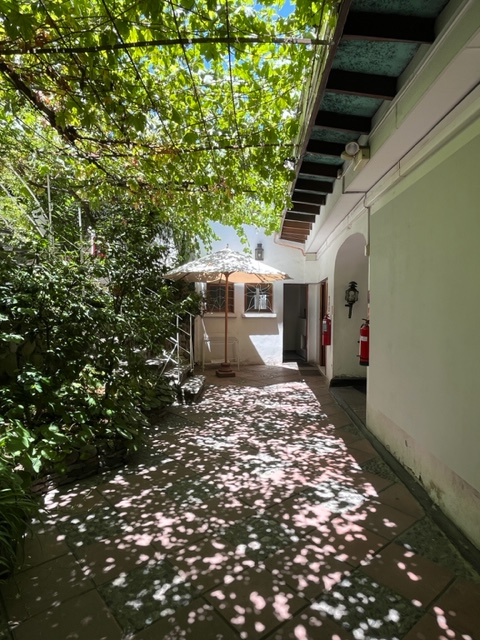
The small courtyard with tall trees forms the axial from which clusters of rooms radiate in every direction. Neruda had a grand plan in his mind, and he used this as a template revealing every room section by section and allowing for the element of surprise at every turn. Thus, the flow of the house evolves like water, finding its own path. The whole is quirky, comfortable, tasteful—where stainless steel Parisian bars coexist happily with leather stools from Indonesia, English Wedgewood services sit alongside colorful Portuguese glassware.
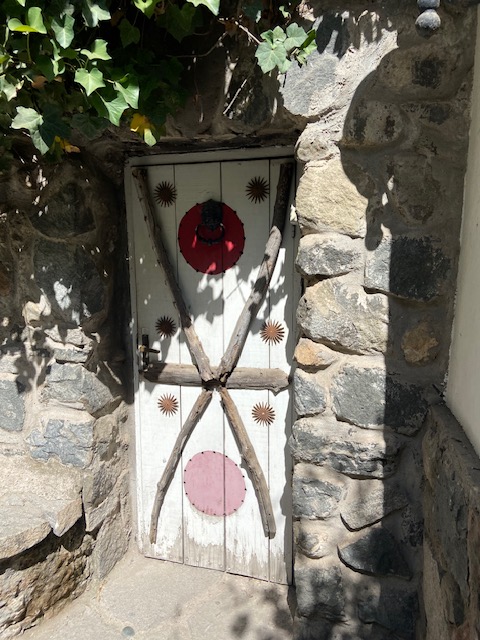
The Catalan architect German Rodriguez Arias, who was hired for the project, witnessed Neruda flip the orientation of the house, haul cypress logs from the south, and modify every detail of the architectural plan. The house began modestly as a living room and a bedroom for Matilde. A kitchen and dining room, two bars—one for each floor– and a library soon began to evolve. Past the dining room and through the kitchen was a small escape route that Neruda could use if he lost interest in the dinner company. No detail was left unattended and all of it was created in service of Neruda’s life.

La Chascona showcases paintings by Chilean and international artists, an African carved wood collection, and furniture from the Italian designer Piero Fornasetti. Built up maximally, the house reflects a rich inner life borne of distant travels, conversations with the likes of Malraux and Hemingway, and the friendship of political shapers of Latin American destiny. Matilde continued living in La Chascona until her death in 1985. After her death, it was reborn as a house museum to provide a window into the life and times of Neruda.

It is only too natural to deify individuals who are no longer with us. Sometimes, it becomes useful to interrogate the vast inconsistencies contained within a single life. La Chascona contains the ghosts of Neruda’s many pasts. But its wandering path up three levels of outdoor wooden steps suggests an upward climb, a constant searching and looking. By the time that I climbed to the top of the tree line myself, I could look further afield. I came to understand that Neruda’s home presented a life that was at once creative and capacious. I saw a life that held many co-existing but conflicting truths. I came to understand that La Chascona provided Neruda multiple ways of being: he could at once roam freely in wide open spaces while upholding his obligation toward his Chilean compatriots. Both pathways were fundamentally important to Neruda and in the end, he chose both.