It is my son, Arnav’s, birthday in distant New York where the winter sun never rises (or so it seems). But in Panama and on the way through the Panama Canal, we turn the corner on our mid-size ship. We have been skimming an endless Pacific Ocean when we come into a sudden view of the skyline of Panama City. The day is just beginning and the city emerges like a golden mirage, backlit by the brilliant light that seems to emerge from both sea and sky. Panama City’s skyline reads like a primer in global enterprise: it consists of mile-high skyscrapers, some as imposing as 60 stories of verticality up in the air. As we squint into the upward sun, we see between two of the tallest buildings a set of adrenalin-seeking junkies zip lining from one building to the other. To avoid feeling vertiginous, we look away by realizing that this is perhaps the only spot in the world from where you can witness the sun rise in the Atlantic and set in the Pacific Ocean with one inflection of your neck.
For inexplicable reasons, I had always wanted to see the Panama Canal. From feeling entrapped by guillotine locks on the European river circuit and marveling at the sight of steel cutting in from four directions, I had felt the desire to witness the Canal. It was a remote plan as distant as the idea of the Panama Canal was when it first began to take shape in the 1850s. But in our world, word had emerged that beginning in 2025, tariffs imposed on passenger ships slicing through the 50-mile waterway would become unaffordably high. And indeed so. It appeared that in the early days of 2025, we were one of the last ones to trudge the 10 hours through the Canal, lock-step by lock-step. Following us, most passenger ships would enter Panama City either via the Pacific or the Atlantic but not through the Canal. They would no longer witness the fullness of the sunrise over the Atlantic and setting quietly into the Pacific.

That’s why it made a whole lot of sense to settle into David McCullough’s brilliant work on how the Panama Canal came to be and thereafter, to go there. We had to witness for ourselves how a series of ‘simple’ engineering solutions would make the Canal one of the guiding routes of world trade and one of the most profitable business centers in the world.
Our guide was McCullough’s 1977 book, The Path Between the Seas: the Creation of the Panama Canal, 1870-1914, which referenced the beginnings of Panama City and the Canal that gave it its lifeblood. The Panama Canal Museum Collection at the George A. Smathers Libraries at the University of Florida and The History Channel made the topic come alive for me by providing the stories of real people who made the project a reality: as example, workers who dug through the isthmus and created the Panama Canal. These sources helped me reconstruct as thorough a visual history of the project as I could get given the constraints of time among other factors.
From my sources, I got to know that Panama City was founded in 1519 by the Spanish conquistador Pedros Arias Davila. Even in its infancy, the City managed one of the most important trade routes in the world through which passed the gold and silver mined by Spain. Already, it showed signs of bringing the world together in free trade and economic stability. But the way there was fraught with disease, demagoguery, and the dangers of developing an infrastructure from scratch.
Yet another landmark event pockmarked Panama City’s early history: the fire of January 28, 1671, when the original city was destroyed by the privateer/arsonist Henry Morgan. Thereafter, two cities came to be built on the site: Panama Viejo, the historic district of Panama City, which became a World Heritage site designated by UNESCO in 2003. A new walled city was also built that protected its citizenry against pirate attacks. Today, both parts of Panama City exist in plain sight–the Old Town and the walled city–that are distinct one from the other.

But the specter of modernity that we witnessed from our ship is what remains in our visual memory. Today, Panama City is the nation’s economic crown jewel. And indeed, it is critically interwoven with the story of the Canal that runs through it. As it did in the 16th century, the City sits at the global epicenter of trade and development. In 2024, the Canal’s revenue was around $5 billion, contributing nearly 8% of the total annual GDP of Panama, according to IDB Invest.
As I fathom this complex interweaving, I see that the story of the Panama Canal moves in a three-part sequence, much like its elevator lock system. Here is my understanding of what I understand to be true.
The Personalities Shaping the Building of the Canal Were Gigantic
The Panama Canal is a story riddled with ambition and overreaching, greed and sacrifice. The richness of the narrative is such that it approximates a crime thriller in parts, a case study in leadership sometimes gone awry in others, a romance, an intellectual history of a city state, and a historical tract that traces the development of medicine and sanitation, urban planning and educational development in the developing world.
In broad brushstrokes, France, Spain, Columbia and America fought a hard fight for the rights of the waterway. Buoyed by the success of the Suez Canal in 1881, Ferdinand de Lesseps–the architect of the project– was hired to build the Panama Canal. The French led by de Lesseps advocated for a 3-lock system on the Caribbean side at sea level. But this plan failed on arrival because de Lesseps had underestimated the difficulty of the terrain, the persistence of disease caused by extreme rainfall and humidity, and the lack of professional engineers on the ground to recalibrate the project at every turn. During this time, Gustave Eiffel of the Eiffel Tower fame, sided with de Lesseps and went to war with their lesser recognizable American counterparts–research oriented engineers who looked to the macrocosm to arrive at common-sensical solutions to their immediate problems.
In the background lurked important business tycoons–Cornelius Vanderbilt who desired a Nicaraguan Canal as opposed to the one that cut through the isthmus of Panama; and Henry Aspinwall, whose mail courier business inadvertently led to the development of the Panama Canal Railroad. The story of the Panama Canal was starlit by these personalities.
At the outset, France won the contract and began the project. But simultaneously, the leader of the project–de Lesseps–decamped to France, directing his designees from thousands of miles away. It was almost certain that France would fail and when they did, the Americans took over the project in 1903. The US went on to spend about $350 million to build the Panama Canal which was inaugurated in 1914 at the start of the First World War.
The Panama Canal Railroad
It all started with the development of the Transcontinental Railroad along the Canal route, built 1848-1855. The railroad literally cut thought the narrow 50-mile isthmus with the labor of hundreds of European, West Indian and Chinese laborers. It is said that rubble from this digging would have buried the entire area of Manhattan under 12 feet–such was the scope of the project even at its beginning. The American engineers planned to create a waterway through rather than around and the Transcontinental Railroad led the way by following the projected path of the Canal and allowing for the free movement of equipment and goods from coast-to coast.

“It was a megaproject of engineering that changed the world with the help and the hands and the sweat and the blood of thousands of people of 97 nationalities that came together on this very small isthmus,” said Ana Elizabeth González, executive director and chief curator of the Panama Canal Museum.
Because of this project, thousands of laborers were housed in make-shift homes that had plumbing and therefore sanitation. Disease was controlled by the medical facilities that were established; schools were set up for the education of the families of workers; and an entire infrastructure was built that led to the fairly smooth functioning of society. All of this was not without struggle. The Panamanian climate of rainy and humid conditions; the prevalence of disease; the fight against the tropical landscape–these were some of the constant barriers in the fight toward a successful outcome. Even so, the Transcontinental Railroad was the artery that ran through the isthmus, It became largely instrumental in the construction of the Panama Canal and in making easy the independence of the Republic of Panama in 1902.

The Panama Canal
The ingenious mechanism built in 1914 that works just as effectively today: the American focus in developing a Canal that linked the Pacific to the Atlantic allowed for a miraculous engineering feat, one that required no digital control, no AI, no wave of the 21st century to come. Instead, it relied on time-tested, mechanical operations run by electrical and hydraulic energy to control the passage of ships from the Pacific Ocean to the Atlantic Ocean, and vice versa.
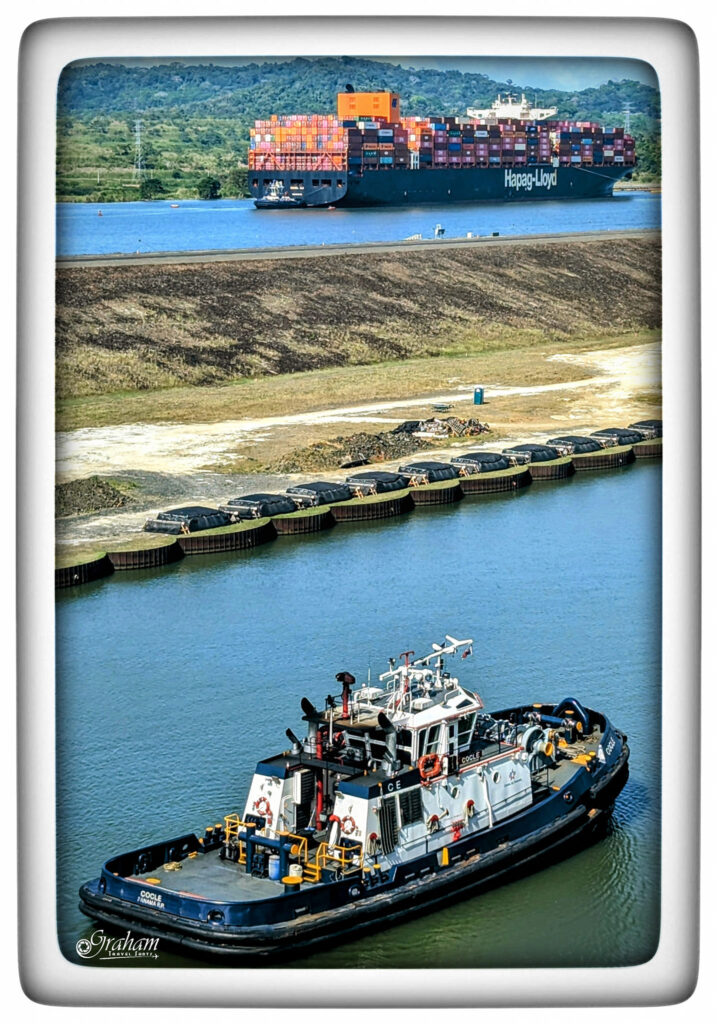
The Panama Canal itself is designed as a 3-lock system–at Miraflores, Pedro Miguel, and Gatun. A lock system helps all ships cross between the oceans, from a small ship to a major cargo vessel. To ensure smooth sailing through the complex system, captains are required to surrender control to one of the Panama Canal Authority (ACP’s) pilots for the journey of eight to 10 hours. On our journey, a small catamaran with 10 passengers lay in our shadow on the same berth asking us to take pictures of them from our towering presence and texting it to them.
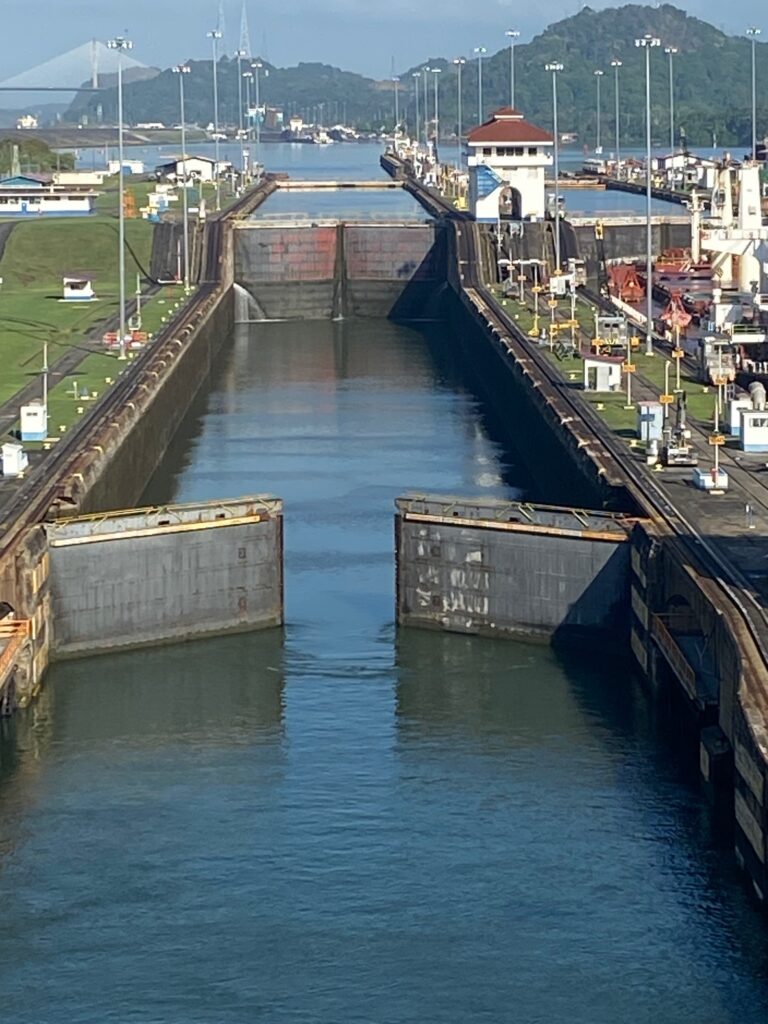
The lock system uses an elevator to lift ships 85 feet to the main elevation of the Panama Canal and lowers them down again. The ship moves steadily up and then they are lowered down in the three locks at Miraflores, Pedro Miguel, and Gatun.

The lift–the amount by which a ship is raised or lowered–in the three steps of the Gatun locks is 85 feet; in the two-step Miraflores locks the lift is 54 feet; and in the single step Pedro Miguel locks –31 feet. The Miraflores locks on the Pacific side varies between 43 and 65 feet because of the tidal difference on the Pacific. This same effect is not felt in the Atlantic.

Our guide on the transit through the Canal reported that each lock chamber requires about 27 million gallons of water to fill; the same amount of water has to be drained from the chamber to lower it again. This water is moved by gravity and is controlled by huge valves in the culverts.
The culverts draining the water, the lock walls and chambers, the gate machinery, the hinges, the two leaves of each gate all of these were precisely engineered to prevent accidents.

The size of the original locks limited the maximum size of the ship that could transit the Canal, and was known as Panamax. The waterway underwent a multibillion-dollar expansion in 2016 to accommodate NeoPanamax vessels, the supersized container ships and bulk carriers unheard of in the early 1900s but now increasingly common on the high seas. The locks were one of the greatest engineering feats ever to be undertaken, a feat comparable in size to the Hoover Dam that was built in the 1930s.
In its history, the Panama Canal has faced limited accidents. There have been near collisions, collisions with bridges, a single sinking in Lake Gatun in 1914, and an oil spill by a cruise carrier. But the maximum number of deaths on the Panama Canal occurred during the construction of the Canal with construction workers facing dangers like explosions, flooding, and unstable ground. The History Channel estimates that 25,000 workers lost their lives with the demand for artificial limb makers”clamoring for contracts with the canal builders.” (“Why the Construction of the Panama Canal was so Difficult – and Deadly,” Christopher Klein, The History Channel, September 15, 2023)
At the Canal’s main visitor center in Miraflores, about 850,000 visitors arrive each year to see maritime trade happening in front of their eyes. With Trump’s interest in the Canal, thousands of visitors are taking tours along the water or to other spots along the canal route. That number is set to rise with Americans making up the largest chunk of visitors.

The Canal is Inaugurated 1914
“The Land Divided, The World United” was the slogan once appearing on the seal of the waterway. Indisputably, the Panama Canal’s success in controlling the movement of trade and becoming itself a highly successful profit center, has forced super powers to pay attention.The Canal serves about 15,000 ships each year according to Statista. Since its opening, ships reduced their travel time by a whopping five months and a distance of 8,000 miles (12,875 kilometers) by cutting through the Canal. Instead of going around the Chilean Tierra del Fuego and Cape Horn, they can now easily access the East and West coasts of the Americas, in addition to Europe and Asia.
The Panama Canal has been recognized by the American Society of Civil Engineers in 1994 as one of the seven wonders of the modern world. Its success was predicted by President Roosevelt’s site visit to the Canal when it was being built and President Woodrow Wilson triggering the explosion of Gamboa dike in October 1913, flooding the final stretch of dry passageway at the Culebra Cut. He did this long distance from the White House.

In 1977, a treaty signed by President Carter and Panama’s leader, Omar Torrijos, ceded American oversight of the Canal to the Panama Canal Authority (ACP). ACP assumed full control of the Canal on December 31, 1999. As the modern-day 50-mile long aquatic highway, the Canal ferries 5% of the global trade through the canal each year,. The US continues to be the heaviest user of the Panama Canal with 66% of the Canal’s cargo beginning or ending at a US port, according to data from 2019. Run by the ACP, an autonomous government entity, the Canal connects 170 countries via 1,920 ports,

The Panama Canal is at once the heartbeat of the global universe as well as a bridge bringing together different parts of this enterprise. On a decent day, the Canal resembles a two-lane highway through which mammoth ships lumber lazily along. Much is happening behind the scenes that belies the serenity of the landscape. And it is this double consciousness that makes the Panama Canal more enthralling as a global player in the marketplace.