Only the fearless come to Antarctica. Our historian from Johns Hopkins University, Richard, tells us that at last count, only .002 percent of the world has visited Antarctica, ever. I imagine a barren, brutal landscape standing brilliantly at the bottom of the world. But what I see defies imagination. Antarctica is not only teeming with the possibilities of life, but it is thick with the fatness of the continent itself: a rich cornucopia of creation which is marked by human absence. Our research crew on the 200-passenger expedition ship, Silversea’s Cloud, carries us over the dreaded Drake Passage and into the mainland of Antarctica. Today, the Drake Passage is calm, and we pass effortlessly through it. We are not going as far as the Ross Sea and the McMurdo Research Center, which is truly at the bottom of the world. We are sailing the Weddell Sea across the Gerlasch Straits and into various points of the Antarctica Peninsula, a route that Shackleton himself crisscrossed more than a hundred years ago. Our route is not intended as a facsimile of Shackleton’s journey on the Endurance; we are firmly on the path of our expedition ship.
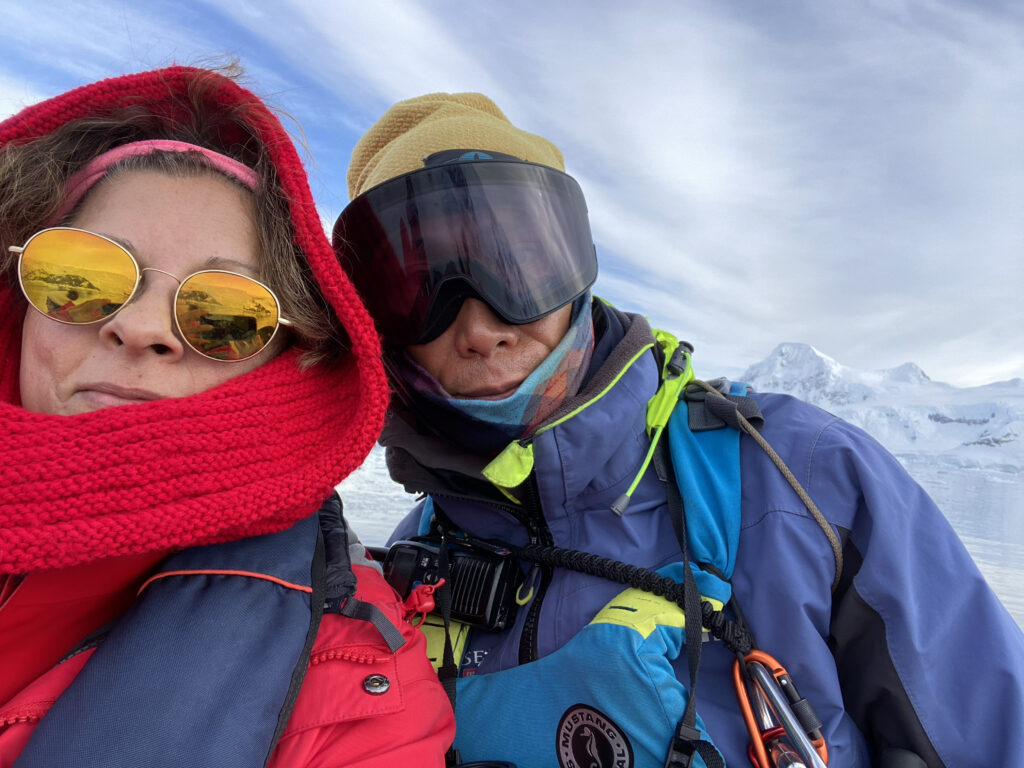
On board are a fierce group of marine biologists, historians, glaciologists, ethnographers and cartographers, artists, hydrologists, meteorologists, cetologists (those who study whales, dolphins, and porpoises), acousticians. They form a ruthless band of dreamers, a group of people who will give up everything that they own to travel the world and learn from its abundance. CK, for instance, is a Mandarin-speaking fiery lightning rod. Once centered in the fashion industry of Hong Kong, now he spends his life in the wilderness: summers in the Southern hemisphere in Antarctica, and summers in the Northern hemisphere in the northern most Arctic regions of the world. These are the dedicated dreamers, the full-time, all-in kind of wanderers who believe so much in the sanctity of our planet that they will unravel the fundamental design of their lives to live close to the earth. Global warming is real, CK tells me, his eyes over-flowing with tears. Unless we do something in our world, we will not exist any longer. As if this is not a death warning enough, he tells me that if all the icebergs in Antarctica were to melt, sea levels would rise over 180 feet. Human extinction is almost assured, he reiterates, looking at us intently to make sure that we have heard.

The sentiment is jolting but in this brutally pristine landscape of Antarctica, it arrives with an uncommon expediency, an unnerving cadence. We are not professional dreamers, just the weekend variety. The ringleader of the group is perhaps me, an established wanderer of sorts. Smitten by wanderlust from a very young age, I have a desire to travel to unknown destinations, to feel the world in my hair and to talk to complete strangers about what matters most to them. For this trip to the 7th, I’ve gathered a motley crew of my husband, Shekhar; my sister, Oli; and our friends Natasha, Debjani and Karno—who enliven our days with energetic mother-son repartee. We have come here with hopes of embarking on a pilgrimage. But we find the experience way more immersive, exploring land and ocean for up to six hours a day in -8 degree temperature. In the afternoon, we sit shoulder to shoulder–students in an auditorium– and diligently take notes. The lectures are grounded in experience and take us to unknown ideas. On this continent, we are experiencing first-hand the overwhelming recognition that we have never been in control of our universe, only of our own responses to it.

There are multiple entry points into Antarctica and each one of them merits at least a book. I ponder these ideas as I feel my presence/absence in this vast continent. I could engage with Antarctica by noting its diversity as the veritable United Nations of the world, owned by no one country, but its resources protected by the United States, the UK, Chile, Argentina, Norway, France, New Zealand. I could talk about how 98% of the continent is uninhabitable and largely unexplored. Or how the bird population—albatross, petrel, skuas. sheathbills– are distributed along cosmopolitan principles—or in diverse communities and societies, just like humans. How penguins have a strong site fidelity—or the tendency to return to their homes no matter what calls to them. How birds use stars and the magnetic force of the world to determine their GPS. How the sound of icebergs cracking at their joints match in intensity the sound of male whales, which can be heard from almost 60 nautical miles away according to Dr. Roger Payne‘s haunting recording, Songs of the Humpback Whale(1970). How icebergs are glaciers that have broken away and are made of pure water from 15,000 years ago. How Robert Falcon Scott and Ernest Shackleton both had a common competitor in Roald Amundsen, who made it to the South Pole first. How the highly successful Antarctic Biennale of 2017 effectively brought together artists from all over the world to explore the artistry that is inherent in the science of the White Continent.

In preparation for Antarctica, I read Alfred Lansing’s brilliant recounting of Shackleton’s story, Endurance (1959). Lansing spent a lifetime meticulously researching and imaginatively putting himself in Shackleton’s shoes. I noticed Lansing’s deep compassion for his subject as well as his imaginative over-reach in describing every battery, every misfortune that Shackleton and his men experienced on the high seas. Spoiler alert: the real-life exploration reads like a nail biter. Shackleton and his 27-member crew, each person chosen intentionally and a stowaway, voyaged to the end of the world in the hope of setting a record. They were thwarted from their goal by less than 100 miles when their ship, Endurance, became mired in ice floes and eventually sank. Shackleton and his men were able to retreat and landed on Elephant Island, named for the elephant seals that bask on solid ice. While Shackleton and five others went for help, 22 men lived on this open spit for more than 18 months between 1915-1917. It is a testimony to Shackleton’s greatness that he made it back to rescue his men and return to England with everyone accounted for. While Amundsen holds the record for being the first to the South Pole, Sir Ernest Shackleton’s story remains larger than life in the public imagination. Lansing’s account, which studies Shackleton’s persona, his leadership style, his planned and unplanned expeditions through those years between 1915 and early 1917 is a must-read for those wanting to experience Antarctica. In fact, it’s on Shackleton’s account that Antarctica gets situated so dominantly in the public imagination in our time.

Like Shackleton, I see that the scope and scale of this 7th continent are almost incomprehensible. The defining themes that help me get a sense of the place are….

Time
Time is timeless here. Being in the Antarctic for a good ten days, I became enveloped in the sounds of stillness. Everything stood massively, monumentally, as if time had chosen to express its timelessness by standing still in real, temporal time. Seeing nature stand, I too followed along and practiced folding into my own silence until I could barely hear my own heartbeat.
I witnessed paleologic time, of time deeply embedded in the underwater volcanoes and icebergs—a time that is deep and vast and reveals the biogeography of creation. This stands in contrast to temporal time—of time that belongs to a human life and which can be measured in cycles, seasons, phases, months and years. And unsure about how to focus on the shifting gauge between the finite and the endless, I became exclusively aware of the present moment. Nothing mattered except the sheer now, requiring a massive mind dump of past and future time.

Light
In Antarctica, summer daylight persists like an unwelcome guest for 24 hours. The sun never sets although the light does a soft fadeout for a couple of hours every day. Most other times, the light is in full focus as it spotlights, mirrors, reflects, and refracts everything in sight. The light is sharp and piercing, reflecting the whiteness of land, refracting the double and triple image of sky in land and in water, so that the landscape from one’s window looks like a giant kaleidoscope. There is nothing to do except to immerse one’s self in the rawness of this beauty.

Absence of human presence
In this landscape, the presence of humans is completely absent. For this reason alone, perhaps the 7th is the last bastion of unspoiled nature, of an ecosystem devoid of human intervention. To become more attuned to sustainable practices, we were schooled in these ways of living:
- Attend a lecture (or read a book or listen to a podcast) on how to leave a smaller footprint on the planet;
- Shower for five minutes less every day;
- Write reflectively;
- Switch off lights when you leave a room;
- Take as much food on your plate as you will eat—don’t waste food;
- Become community-centered and less reliant on your car.

In the end, Antarctica left me with an urgent need to do practical things in the real world, action items that will privilege my comfort less and the planet, more. Science tells us that we are clearly at a tipping point. Unless we change our ways, we will most certainly lead to our own extinction. This is the only occasion—in real time—when we can reverse the narrative. We can choose how to respond to our world now or never. And then we will have to forever hold our peace.
(Some photos courtesy of fellow travelers not seeking acknowledgment for their work.)


Stunning images in these photos. What a memorable trip!
Carol:
The kindness of strangers is awe-inspiring. It remains our most powerful expedition trip for this reason too…
Absolutely incredible Anu, thank you for taking me into a world I will never get to, and bringing the lessons along with you. I am so grateful for this blog!! The photos are stunning, as well as the numbers – how many visitors, rising tides, temperatures. Your writing is forceful and beautiful. Thank you.
It was likely my most unexpected wandering and I loved it….and tried to do justice by it. It is a big continent with massive challenges and my hope is that our grandchildren get to enjoy the force and wildness of amazing nature.
Images complemented your write-up very effectively. Tremendous experience. Loved your forewarnings about conservation; surreal!
Thank you so much…glad that you enjoyed wandering with me.
thank you so much, Rupa.