New York in the summer is a sure recipe for heartache. There is something in the air, a fragrance wafting from the direction of Carl Schurz Park, say, that makes you stop and look around. The city feels new as if it has undergone an exfoliation of dermis and epidermis. Old skin has been ceremoniously removed. A rebirthing is in process. The leaves are freshly minted, the horses high-footed in their clip-clopping around the city streets, the air is thick with expectation.

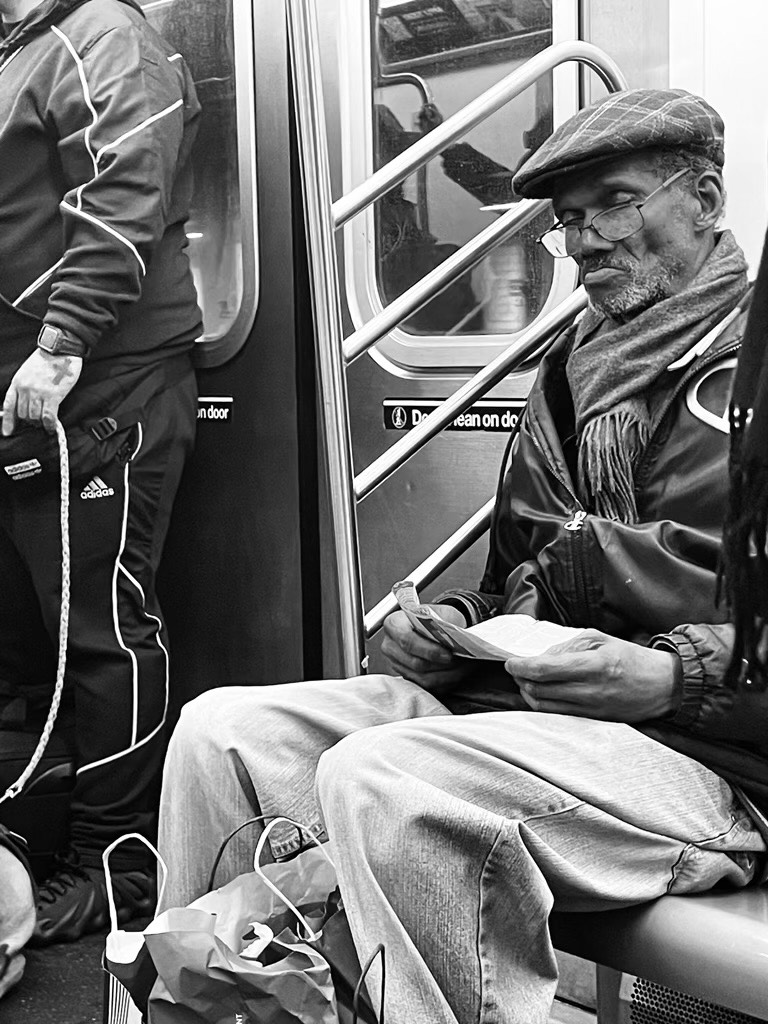
Am I the typical tourist who is awe-struck by New York? Not so. In fact, this is the city of my initiation into American life. It is the city where I found a rebirthing when I arrived here as an international student in 1980. This is where my life began again and this is where I grew to be the person I am. For this reason, I love New York in all its avatars—its paranoid misgivings, its energy, its artistry, its chaos, its wild and feral beauty. But after spending much of my adult life in the American Midwest, I find myself yearning for the dullness of routine, the surefootedness of predictability. I can only take New York City in spurts any more, knowing that I can flee its electric energy and return to the quiet of my Midwestern existence at any given time. Even so, I visit the City several times a year, so gripping is its magnetic overreach to us in the faraway hinterlands.

Olivia Laing wrote that New York is perhaps one of the loneliest cities on the planet. And this is evident in the faces of people walking by, their faces monolithic in their isolation, their eyes dulled into automatic by the lack of human connection. Edward Hopper got this alienation spot on, of people staring out of windows into a teeming landscape but seemingly focusing nowhere, remaining all alone in the world.
This time around, I am staying in New York for a full two weeks. I tell myself that I want to feel like a certified New Yorker, on first-name basis with Johanna at the local bakery between First and York. I want to befriend our local laundress, Mrs. Ma, who is impressed with my beginning Cantonese. I want to get to know the local UPS storekeepers, the Tal-ben Bagel shopwallahs, the Italian, Lebanese, and Honduran eateries all within a few blocks of the other. I want to know my Bangladeshi fruit seller who plays lesser-known Johnny Cash songs on a radio hung on a clothesline. The lucky ones who successfully guess that sooty, coal-like voice, gets to take home a free fruit. I want to know my neighbors from Mt. Sinai and Sloan Kettering, their stories, how they got here, what they have made of their lives. And it is this search for connection that keeps my mind from becoming lost in my own wanderings.

In my aimless wanderings in the City, I find my people not only in the alive company of our adult children, whom we visit by dusk. But by day, I turn to the faces lining the walls of city museums. Each time in New York, I go to the Met (only a few blocks away from our pied-a-terre) and MoMA, and then I add on one more with each visit: the Museum of the City of New York, the Tenement Museum, the Frick, the Guggenheim, the Whitney Museum of American Art, the Museum of the Moving Image, the 9/11 Memorial and Museum, the Ford Foundation, Asia Society, P.S. 1, the Brooklyn Museum, galleries in Tribeca and Soho and Chelsea, and the list goes on. The offerings are so plentiful that one could spend an entire lifetime here and only get to know New York as a speck on a pointillist canvas.


Today, I have come to the Met to get to know some humans in whom I’ve had a passing fancy. Once within the museum walls, I strategize my reach. I will meet two individuals in half an hour and I will get to know them best I can. Speed-dating you may call it, and this works for me as an antidote to my loneliness. These are the characters who are so entirely memorable in how they present themselves that they have become alive to me. They define not only their times but also an ageless present in which I feel recognized.
I first meet Bronzino’s Young Man created in the 1530s. He is by far one of the prettiest boys that I have seen, serving as an advertisement for material excesses of the most opulent kind. Gorgeous architectural details in his background speak to his class and the wealth—which as we can see, he enjoys immensely. He stands lord and master of his domain by mansplaining in clear sight. His slender fingers—not used to manual effort of any kind—appears boneless, it hangs loose like a piece of elastic, dipping into not one but two place-settings in a book that he has on view. This gorgeous piece of eye candy not only possesses physical prowess, but he also has intellectual might. His other hand deftly assumes the quintessential Renaissance pose—his elbow breaking through planes of reality and jutting into the viewer’s space—showing that he has the authority to do just that.

Our young man’s clothes could be right out of the pages of a Bergdorf catalog. Akin to the likeness of 21st-century acid-washed jeans, this young man’s clothes are distressed by volition. The satin threads running through his shirt are intentionally plucked out to give it a splintered, carelessly shabby look. The fact of a perfectly styled expensive piece of couture being defaced (somewhat) speaks to the wealth of this individual: he has the money to look like the common person (sort of) while living in the excess of haute couture. He has arrived and he knows it.

1530s, Metropolitan Museum of Art
This air of supreme contentment typifies sprezzatura, a feeling of high confidence, of being in grace under pressure. Our young man’s gaze holds the viewer steadily with one eye, while the other eye—a lazy one to behold—surveys the landscape to assess what dangers may lurk in the background. I wonder if this is indeed a physiological aberration or a psychological one, meant to unnerve the viewer so that they question the ground on which they stand. One thing is clear though: the viewer could never be on par with our young man here. There is so much to notice here. Is it ever possible to know another?
I keep wandering the galleries and come to the next person who calls my name. I see a young girl looking straight into my eyes. She is Mäda Primavesi, who lived during 1903-2000, and whose portrait was painted by Gustav Klimt in 1912-13. Mäda was barely nine years old when she was painted but her confidence and deportment belie her age. Where Bronzino’s young man is a picture of ideal beauty, Klimt’s Mäda is a real person. Her young but mature face looks just like her, as is evidenced by the photographs of Mäda that remain.
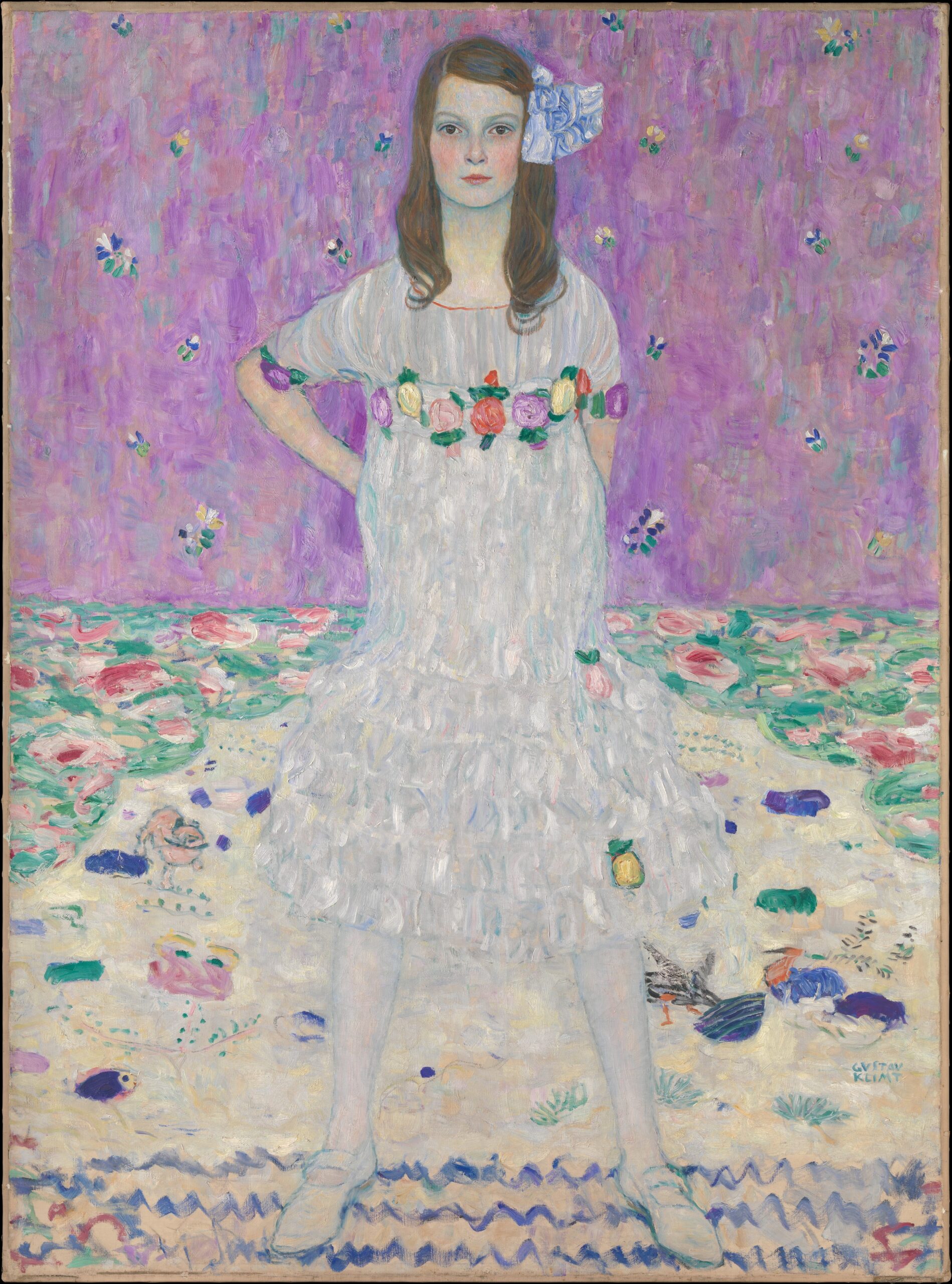
Prior to her death in 2000, Mäda visited the Met regularly and spent hours looking at her portrait—one that was commissioned by her industrialist father and her progressive mother. Both parents were known for hosting decadent salon-like gatherings at their country home and supporting the community of artists and architects called the Wiener Werkstätte. They were undoubtedly familiar with Klimt and his contemporaries.
Leading up to the years of the Second World War, the Primavesi family lost everything: their stature, their sense of belonging, their peace of mind. Mäda’s portrait was seized by the Nazis in 1938 but fortunately returned to the Pulitzer Steiner family in 1951. In 1964, it came to the Met by way of a gift of the Pulitzer Steiner children.
In terms of how the painting came to be, Otto—Mäda’s father—commissioned the seven-foot portrait as Klimt’s only major work featuring a child. To prepare, Klimt created numerous studies of Mäda perched atop a chair or leaning forward. The pose that made it to the final frame involves the girl staring directly at the artist, her legs firmly parted, completing a perfect triangle in the shape of her stance. Her arms hang behind her back, almost defiantly. Here is another sprezzatura moment highlighting the sitter’s extreme confidence. She will not be phased and she is here to tell you so. In the portrait, Mäda is standing tall in a white dress surrounded by a sea of color and pattern. The picture testifies to the sophisticated taste of her parents, and the hand of designer Emily Flogge who was a master of color and floral prints.


How is it ever possible to be alone in the City when so many interesting characters exist in plain sight? So many stories are waiting to be told. So many insights await to make us come alive in the moment. As Gustav Klimt noted, we can often know the painter (or writer) through their work. If you are looking for a connection, look no further than in your immediate line of view.

“Whoever wants to know something about me… should look attentively at my paintings and there seek to recognize what I am and what I want.” Gustav Klimt
All Photos are Courtesy of Amy Karlen, New York City