Loading...

Setting out for India: October 2023

We’ve been up all night, trying to ignore the thud thud thud of wetted newspaper balls ricocheting off our Over the Rhine (OTR) windows in Cincinnati. We have a whole bank of windows and we let in the light even when it is inconvenient. To feed our idiosyncrasy, we leave the shades up all night. This is FOMO in real time, giving us unobstructed views of our newly-discovered cityscape–where people come and go at all hours of the day and night. We have committed to living in our sun-drenched OTR apartment for half a year in between the sale of our Frank Lloyd Wright-inspired home in pastoral Indian Hill and the remodeling of our condo in urban East Walnut Hills. But this is getting far ahead of our story. 

I want to say that everything is connected, sometimes, willy nilly. Even when things don’t seem to add up, in some faraway place and time, they do, shazaam, and one is left wondering how one might have missed the connectors in the first place. 

So, just past Taft Brewery on the way to the FC Cincinnati football stadium, we see two young men in a black, 4-door sedan, in their early 30s, Caucasian, wearing baseball hats, one with scruffy facial hair and the other clean shaven, dark sweatshirts and khakis. They are dressed alike not unlike typical Ohio kids of a certain socioeconomic strata. Ohio parents tend to dress their Ohio kids alike when they are growing up. So when the District 1 police shows up six hours later, the identifiers are convenient beyond reason, a pass given to us without the asking. We have observed these two since 12.30 a.m. and we have begun to construct a narrative of who they are. They are baseball-bat wielding angry young men who hide their firearms under their sweats? Or ax murderers avenging past vendettas? After all, they’ve been watching us through our open window and have begun to build their own case history of who we may be. We live out our story all night long, looking through tiny portholes in the slats of the window shades, now pulled down for partial anonymity. 
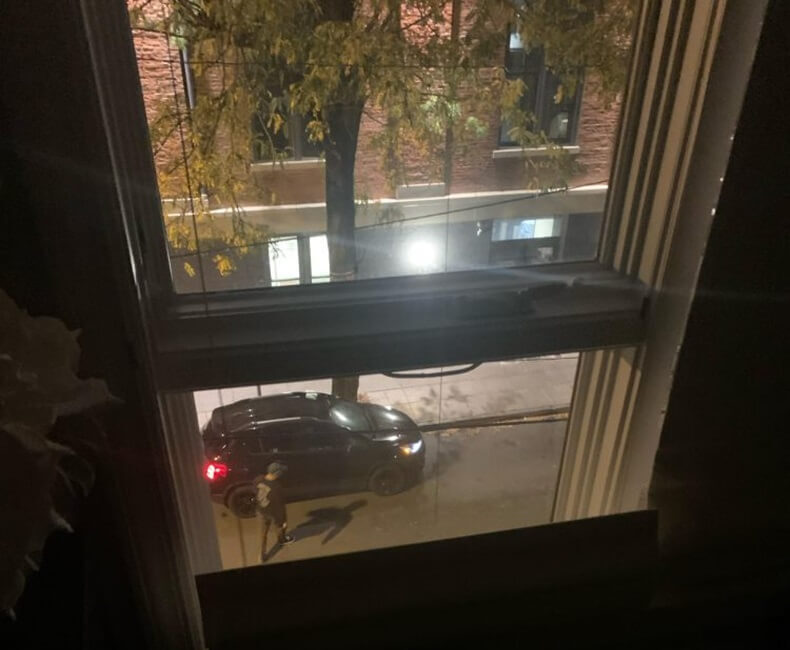
A view from Apartment 203

But fast backward and it is just after midnight. We are padding around like swaddled babies in our billowy jammies. We are just back from the Cincinnati Durga Puja, a celebration of the goddess force that draws a thousand people from all over the Tri-State area of Ohio, Kentucky and Indiana. Returning past midnight in Over the Rhine is a no-no, and it doesn’t help that I look like a lit-up, Dan Flavin neon sign in my richly embroidered teal Benarasi silk sari. I am wearing gold and filigreed jewelry called kundan which is worn particularly during auspicious celebrations. 

Somewhere, through an open window we hear a raspy woman’s voice breaking the night quiet, “Sir, will you stop ringing my bell. I am not expecting anyone at this hour.” The whole experience is surreal—the goddess, midnight in the OTR, two young men in a black sedan, how does the calculus tally. 

This is when we decide that’s its safest to go to bed. In a few hours, we must rise for our journey to New York and London and New Delhi and Kolkata (formerly Calcutta). This is the season of Dussehra and Durga Puja and it is the Super Bowl of all Indian festivals. Dussehra is to Indians and Hindus what Christmas and Eid-al-Fitr and Hanukkah are to the monotheistic religions of the world. We are traveling to our family home in Kolkata to witness the festivities and not having seen it for many decades, our excitement is close to electric. 

So when the alarm goes off at 6.30 a.m. and our lights switch on, we smile. But the familiar refrain of thud thud thud is disquieting. This time, the taillights of the black car are on. A couple of honks and then an yell in acknowledgment of our burning light: “For God’s sake, will you let us in?” And this is when the District 1 Police is summoned. Suspense follows, hearts palpitate, finally, the results come beeping in: license plate-check, license numbers–check, storyline–check. The youngish police officer tells us that we can let these fools into the house if we wish. These are in fact salt-of-the-earth Canadians driving into Cincinnati for the Sunday afternoon Bengals-Seahawks football game. They are weekend lodgers in # 201 next door. In their excitement to hit town the night before, they broke their key in half and, of course, it is only reasonable to question why they would carry their phones with them when they could very easily leave them for safekeeping in their AirBnB rental. 

We let them in the front door and the story should have ended there…but what I want to say is that the foolish wanderings of two young men about town was hugely inconvenient for me. Singlehandedly, they made me forget my tidy bag of jewelry — my favorite earrings, my pearls, my gold bangles. Thus, I missed every future opportunity to look glamorous during the Pujas in Kolkata. It was my turn to shower inglorious blame on these guys for all the inconvenience that they caused me.

Anu and her friend, Chandni, at the Tri-State Durga Puja in Cincinnati, October 14, 2023.

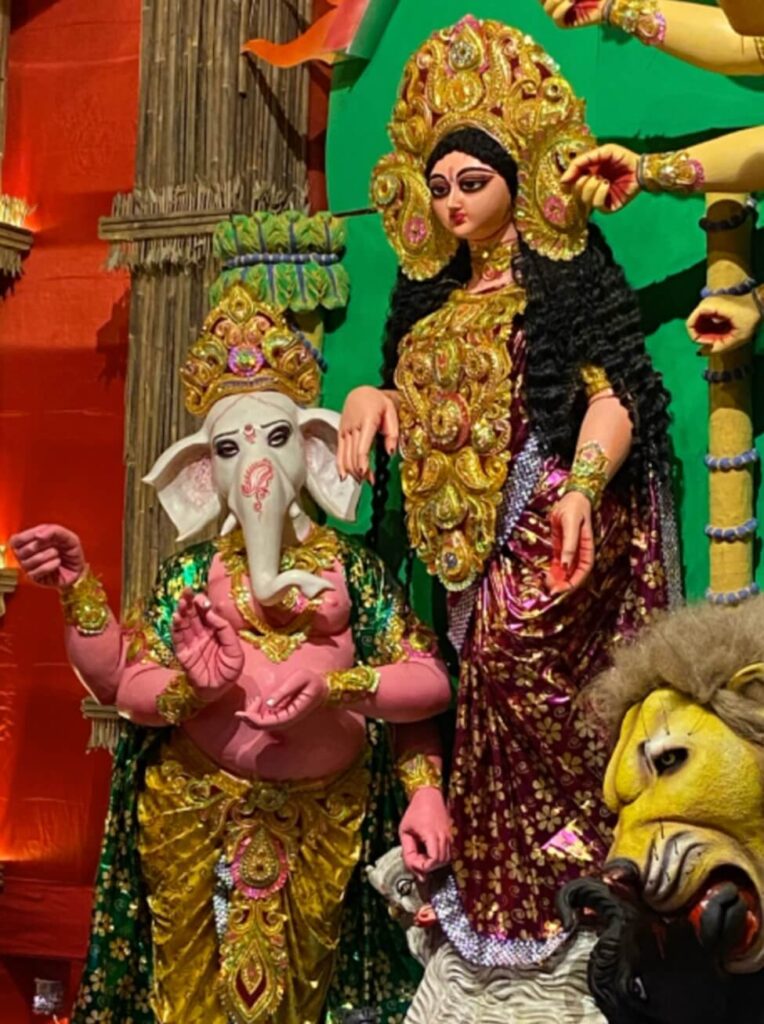
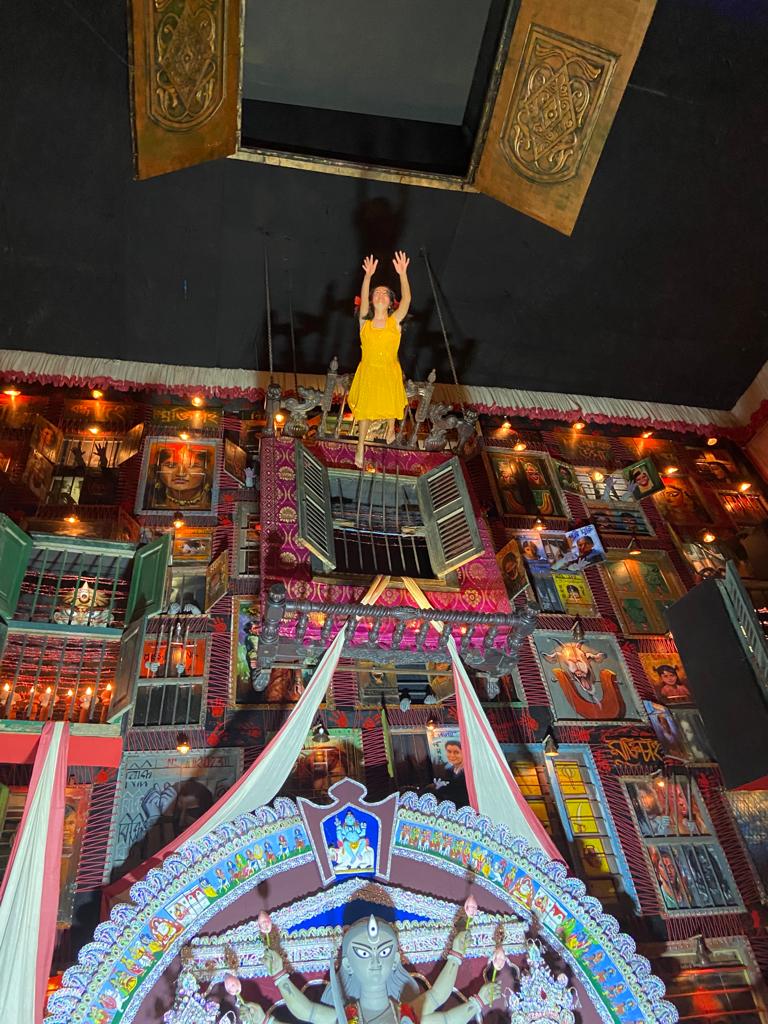
Dussehra and Durga Puja were observed in late October 2023. This is when Durga, the consort of Shiva, comes down to earth on her annual visit, to cleanse the world of all its evils. This she does symbolically by overwhelming the demon buffalo Mahishasura. Durga, along with her four children, reminds us of the daily goodness that surrounds us. Her four children are a constant presence in the lives of all Hindus: Ganesha, the elephant-headed god, removes all obstacles in our path; Lakshmi, the goddess of wealth, showers us with emotional, material and intellectual riches; Saraswati, the holder of all knowledge and wisdom, grants us understanding; and Kartika, the god who represents the balance of beauty in body and soul, keeps us whole. Every year, Durga reminds us that goodness conquers evil and this simple faith sustains us through the year.
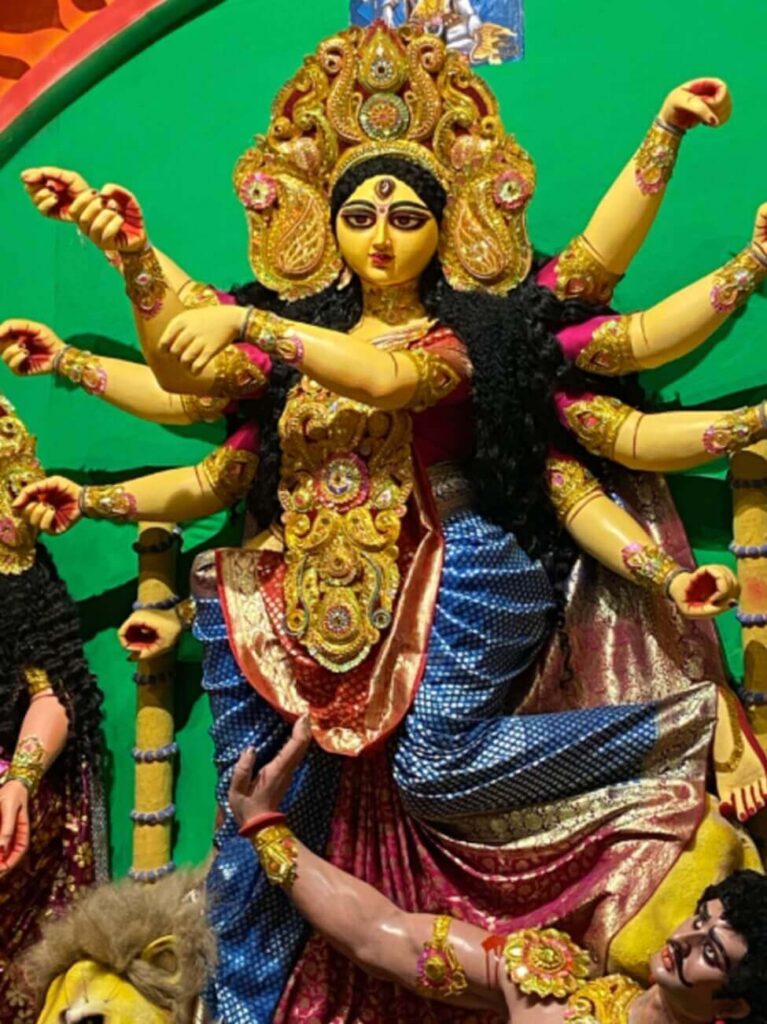
Durga with her 10-arms symbolizing that a woman’s work is never done!

Since 2021, UNESCO has named Kolkata and its season of Durga Puja as a World Heritage Site. As a result, the Pujas have exploded in artistic ingenuity and brilliance. 

It is almost impossible to recognize our daily sources of abundance when war rages in the Middle East and lays bare the lives of thousands of innocents. Human beings suffer viciously all over the world. But in all of this, I am given the quiet reminder that it is risky business to confront the unknown. It goes against our grain to let in strangers in the dark. But if we are brave enough to do so, our ‘enemies’ can become new friends with a history. Sometimes, this understanding is given to us on our own doorstep. And it is handed to us on a platter within our very grasp.
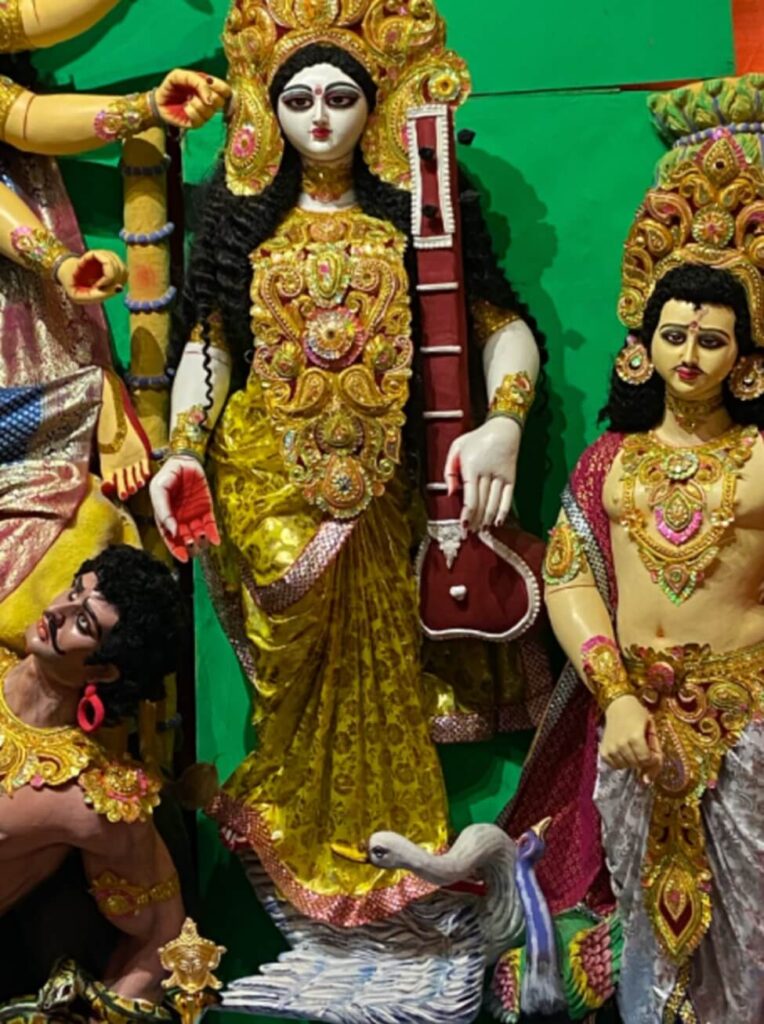
Walking the streets: Durga Puja in Kolkata, India, October 2023

It’s been four decades since I walked the streets of Kolkata during the Durga Pujas. But, in fact, I have returned to the city of my birth every year. Some years, I’ve even shown up twice or three times. And so I am inherently familiar with Kolkata. But it’s been some time and my brain is addled by this time warp, a condition that takes me backwards and forwards in time as I find myself recollecting the past while trying hard to not aggregate it with the present. My childhood friend, Kavita, is visiting from New Delhi and together with her sister, Pinky, we walk the bustling streets of Chorbagan (the garden of thieves) or Hathibagan (the garden of elephants), Tala (lake) or Shyam Bazaar (beautiful bazaar). The past seems palpably present, I can almost touch it and smell it.  And the present looks very much in need of a retrospective gaze. I size up these neighborhoods: far from being beautiful elephant grounds or verdant pastures for thieves as their names imply, they are grimy, gritty, throbbing parts of North Kolkata—sections of town famous for their interpretive images of the goddess Durga. 

With Kavita and Pinky in Hathibagan, the garden of elephants, Kolkata

I could write about what Durga Puja is. Who is Durga and why is she important to the Bengali imagination? What is the foundational basis for the worship of Durga? Who or what is a Bengali? How is Durga made from an artistic point of view? What is the cost of producing the 6,000 odd images that are housed in makeshift ‘pandals’ or pavilions choking an already overcrowded city? When is Durga Puja held? I could chat endlessly about any one of these topics or I could talk about the two Kolkatas—the one that the British ‘discovered’ in the 1680s and named Calcutta, that still maintains a certain colonial stronghold on the mental architecture of the city, or the one that is Instagram friendly, Taylor Swift loving, young and seemingly indestructible younger crowd. (At last count, 800 million of India’s population of 1.5 billion is under 30!). But I want to visit the Pujas in Kolkata today with my longest-standing friends and just take it all in.

A quick primer: Kolkata is the capital city; West Bengal is the name of the state where Kolkata serves as the capital, located on the eastern seaboard of India; Bengalis are culturally associated with the state of West Bengal; Bengali, Hindi and English are the primary languages spoken in this state. 

It is 5 a.m. on October 22, the day of Maha Ashtami—the high point of the Pujas– and I look around with surprised recognition. At once things look familiar and not quite recognizable. We see throngs of people walking the streets. In this city of 16 million (in Kolkata proper), it is only natural to see such a sight, and, of course, with the Pujas, the population has presumably doubled if not tripled. But it is early and already the crowds are as thick as molasses. People all around me look glittery and dewy eyed. Their radiance only accentuates my unmade-bed look. My daughter, Priyanka, is running the Sacramento Ironman today, a world away, and I have been up all night, tracking her on the real-time feed that our son-in-law, Chris, has set up for us. But the ambiance of happiness all around me is infectious and it grounds me in the present. I see people looking hopeful and optimistic, holding on to a slender-ish faith in the future. 

Mohammed Ali Park Durga Puja

And this is when I realize that far from being a religious or even a spiritual practice, the worship of Durga—held over a ten-day period in India and in diasporic communities worldwide—is deeply personal and intimate. It is a celebration without any intercessors, marking the victory of good over evil, of us choosing our own angels in their death fight over our inner demons. Here in Kolkata, the intellectual center of India, the Pujas perform additional functions as well. They are social and celebratory, devotional and political all at once. This year, and because of the state of our world, issues of social relevance have become front and central in many interpretations. Where the central government appears to diminish the rights of women, the LGBTQ+ agenda, and those of other marginalized groups, the pujas bring on a full-hearted celebration of invisible themes existing in clear sight around us. What emerges is diverse belief heaped upon diverse belief that not even Narendra Modi’s politics can homogenize. In the end, the Pujas remain a highly artistic and creative endeavor, involving all sections of society. It is an and-and equation: social, political, artistic, consciousness-raising, and off-the-charts creative. 

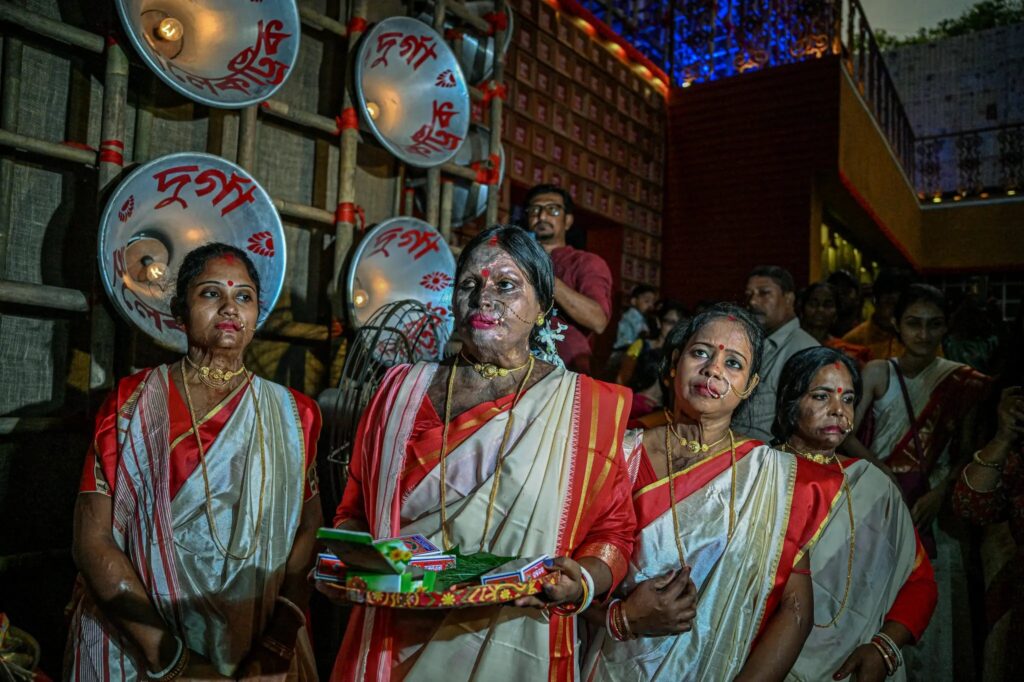
Victims of Acid Attack celebrating Durga Puja, photo courtesy Atul Loke, New York Times

Durga Puja (in Eastern India, where I am originally from), Dussehra (in North and Western India), and Navratri (in Western and Southern India) are essentially one and the same celebration. In impact and importance, it is akin to the Super Bowl, the World Series, the Grand Slams, the Masters’, the FIFA Football Cup, the Grammys, and Oscars– all rolled into one. Durga Puja directly affects more than a billion and a half people in India alone, and many more in diasporic communities throughout the world. For its artistic merit and brilliance, the Durga Pujas were declared an UNESCO Intangible Cultural Heritage of Humanity Site in 2021. 

The Pujas are also a welcome infusion of hard-core cash into the local economy.  Many of the images and the ‘pandals’ in which they are housed run into millions of rupees. In the language of cold numbers, here are some statistics:

  • 300,000 individuals are directly employed because of the Pujas in Kolkata, over a 6-month period every year, with many more experiencing an economic boost based on the industry. (The British Council, 2023, India)
  • The Durga Puja is worth 7% of West Bengal’s total annual GDP. (The British Council, 2023, India).

Today I see the enormous range of human differences which are embedded in similarities. At the Mohammed Ali Park Durga Puja, which is located opposite a fully functional mosque, the Islamic afternoon prayer or azaan blares plaintively over loudspeakers. Meanwhile, the Durga pavilion simulates the Hindu Somnath, one of the holiest of Shiva Temples in Gujarat. The figures are Kehinde Wiley like, in their baroque robes and dramatic gestures. The Telegraph reports that in multiple puja pavilions like this one, Muslim community workers put the finishing touches to the Durga image while their Hindu assistants lend a hand. Mohammed Syed of the Mominpur Tarun Sangha, has been doing this for the last 20 years with his Hindu assistant, Satinath Adhya. The Telegraph reported that “Inclusiveness is ingrained in Indian culture. But the past decade has witnessed a full-fledged attack on this culture. That is why it is vitally important that we should preserve it.”  Adhya’s sentiments are echoed in different parts of the city. (The TelegraphOctober 20, 2023). 

The buffalo demon being annihilated by Durga

The story of Durga itself speaks to this truth: that what is unlikely ends up becoming the norm, that what we sometimes imagine can become our reality. The story itself is Joseph Campbellian, of epic proportions, where the goodness of Durga vanquishes even the thought of evil. 

As consort of Shiva, the head honcho in the Hindu pantheon, Durga is a force to be reckoned with. She is the Goddess figure and endowed with special powers, she confronts the demon, Mahishasura, often represented in the form of a buffalo. Evil, she observes (famously in Birendra Krishna Bhadra’s epic poem, Mahishasura Mardini), is chameleon like—it is often pleasing but its form is mercurial, almost enticing. In other words, while goodness is always available to us, in its predictability it becomes almost pedestrian and unexciting.  Evil, on the other hand, tends to be exhilarating, changing likeness and keeping us sufficiently involved and herein lies its allure and magnetic pull over ordinary mortals. 

Goodness getting the better of evil.

But Durga knows the story line. Mounted on her lion, she pursues the buffalo demon and cuts through its skin. As the blood oozes, the demon can no longer contain its camouflage. This is the cue for Evil to reveal itself; he must out and this he does. In this way, we are rendered an annual homily, a continuous revelation– that goodness and evil can (and does) dwell in equal measure within and among us. The struggle is always painful, giving way to the clarity that it is only through the power of goodness that we can attain understanding and peace. A simple choice—that of loving our neighbor– allows us the bandwidth to become better than who we are, giving us a more expansive way of living with ourselves. 

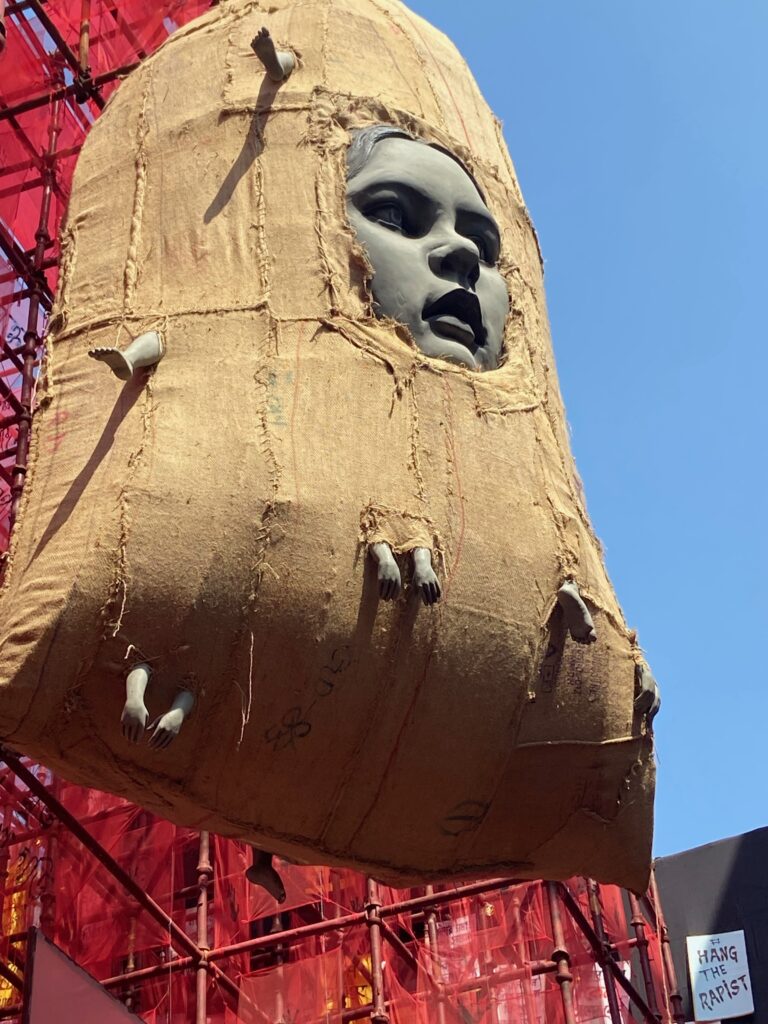
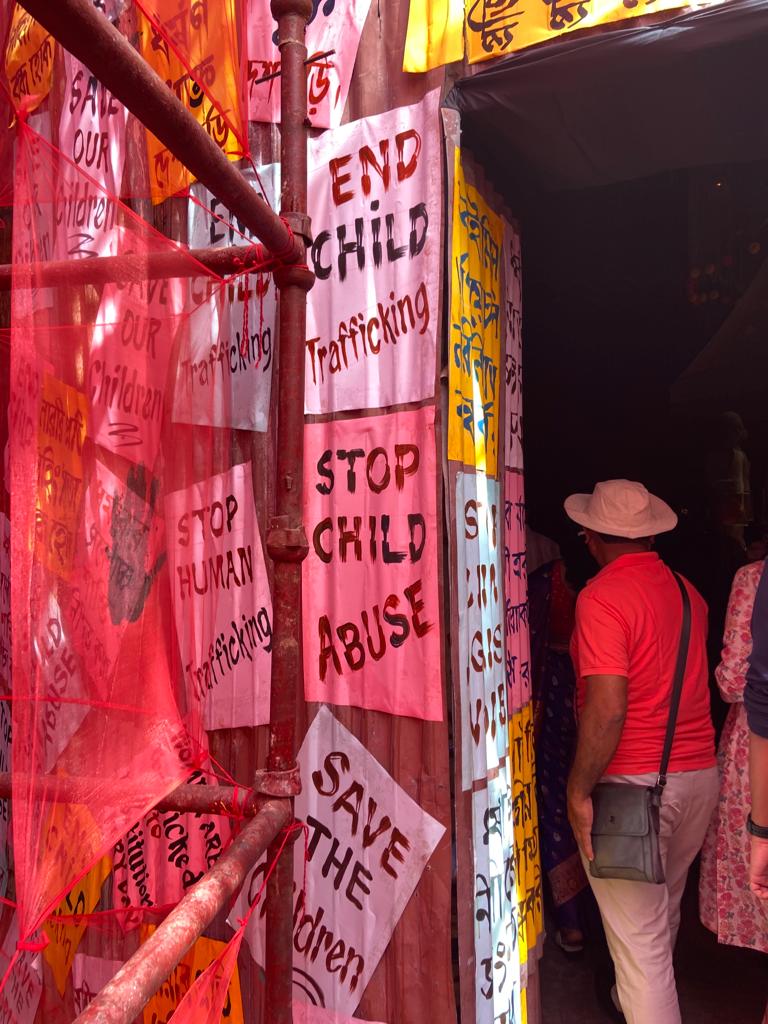
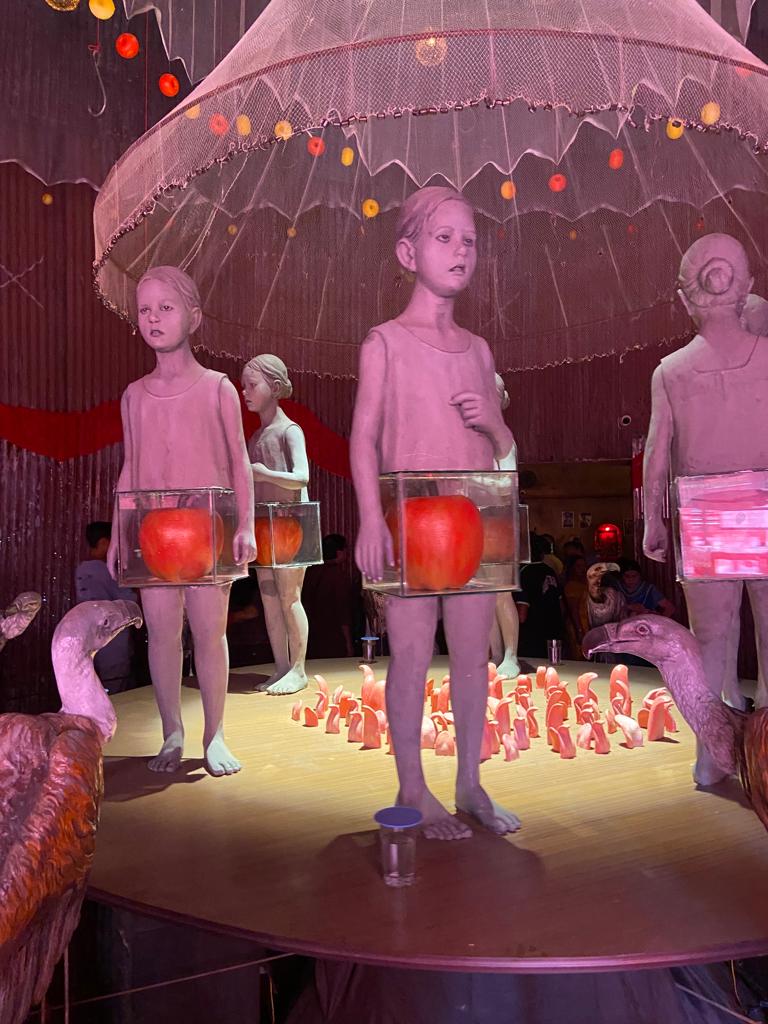
The Durga story continues to captivate the public imagination. Of the 6000 neighborhood pandals or pavilions set up for worship, the one in Kashi Bose Lane is particularly thought provoking. A young child is trapped in a giant sandbag in a contemporary installation. Later, in the various rooms leading to the Durga, young children are paraded on a rotating lazy susan. They are violated by vultures who are seated at the table. Atop Durga, a young child, trapped in a bed, jumps to her death. Everywhere, posters of trafficked children line the pavilion including protest signs urging Death to Rapists and Save our Children as pathways to action. The effect is at once a bone-chilling reminder of the social injustices that exist all around us and a call to action.

A pavilion raising awareness on child trafficking on Sudhir Mukherjee Udayan, Kolkata.

Ultimately, Durga comes to us as an annual reminder of our own power to be good, to do good. By the time that the Pujas are over, she’s left behind communal harmony, an awareness of the injustices surrounding us, economic prosperity, and artistic masterpieces. What more could anybody desire from a single festive holiday where a lone mother is celebrated for her tough love as well as her ability to inspire change on an annual basis. 

La Chascona or the One with Wild Hair in Santiago, Chile: January 2024

The idea of home has always held special meaning for me. Ungrounded at an abysmally early age by the unexpected death of my father, I became rootless by temperament. I came to identify myself with wanderings, a certain discontentment, a specific directionless travel plan that took me from here to there but seemingly nowhere where I wanted to be. Or somewhere that was meaningless to me once I got there.  I became a professional asker of questions, someone who had more of them than answers. For instance, for the longest time, I grappled with the question, why—why was I doing what I was doing?  Scaling mountains? Reading Simone de Beauvoir?  Getting my Ph.D. in British Lit? Watching people wait for the bus?  There seemed to be no prioritizing in my relentless questioning. What held meaning for me? What was meaningless to me?  It was apparent that settling down would take the better part of my life and indeed it did. In fact, it took me several decades to come to terms with myself. Perhaps, even love myself for who I was. And that’s why the concept of home became a setting so profound that at once it symbolized a womb into which I could crawl and a porthole through which I could scan big dreams in the larger world. Home was a place where I could be myself, separate from my perpetual restlessness. My bed marked an architectural landscape that allowed for vertical uplift, grounding and releasing me simultaneously. Home, my home, created with decades of intentional care, held this special place for me: meticulously diagrammed but spontaneously free ranging all at the same time.

La Chascona in Santiago

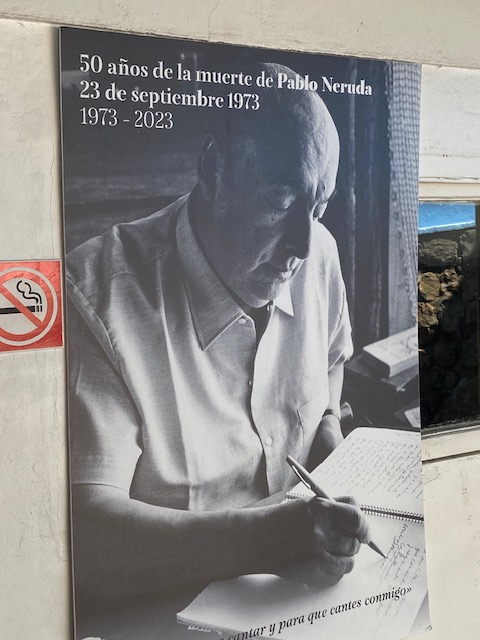
These thoughts lingered on my mind as I traveled down Avenida Antonio Lopez de Bello in downtown Santiago, Chile, to visit the home of Pablo Neruda. I had read his highly emotional slash erotic poems in high school and college, and many decades later, our friend, Ale, gifted me one of his books of love poems. When you learn to read Spanish, she had said, perhaps you will read the book and enjoy it as much as I do. I remembered Ale’s confidence in my abilities, the sheer force of her will in believing that one day I would be able to read Pablo Neruda in Spanish. And that’s why, even after moving homes three times in as many decades, I still hung on to the slender volume with the green cover. All I wanted to do today was to reconcile my impressions of Neruda—of how he presented himself versus how he really was. It made me think of how we construct a narrative of a person based on the coordinates of our own life—and it is this version of reality that we hold onto versus the thing that presents itself to us. For this reason alone, I love visiting the homes of artists, writers, and thinkers. Parsing through a curated home uncovers for me what the person was really like, how they spent their days, what ideas mattered most to them.

Pablo Neruda

These ideas jostled in my head as we cut through the ruthless heat of a Santiago January afternoon. It was the height of summer and the sun bore through my thin cotton shirt and bleached it clean. I stopped to stare at two Santiago traffic police. It was north of 90 degrees, but these two looked like overstuffed penguins in their thick white shirts, skin-tight breeches, and sturdy waistcoats. Somehow, their clothes sat easily on the outer edges of their skin.  This afternoon, the traffic cops, perhaps simmering with an inner rage, were writing up tickets—in a street of 10 parked cars, just two escaped their fancy. I was fascinated by their choice-making: what led to their decision? Why the brutality? 

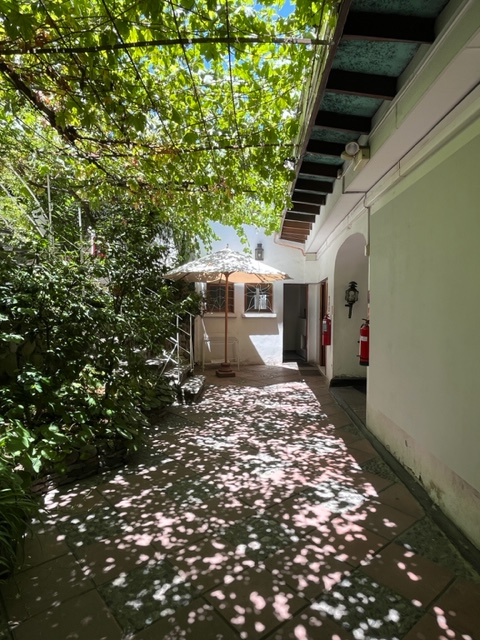
Past a trendy café at the corner, we turned into a quiet street that led to Neruda’s home. An industrial steel gate led into the complex. Pointing the way from the outside were two walls of murals that reminded me of Marc Chagall—at once funny, wistful, mystical, serious, lighthearted. 

Walls of murals leading the way

La Chascona, or the one with the wild hair, was the house that Neruda built for his secret lover, Matilde Urrutia, who eventually became his third wife. They met in Mexico in 1949—she was a Chilean singer who was hired to take care of him when he came down with phlebitis. He was still married at the time but he quietly built this house for their secret love. This is where she lived until they married in 1953. Eventually, La Chascona became a home for both of them —one where Neruda could manifest his various selves and learn to live with his numerous legacies.  In this unlikely nest, Neruda was able to integrate his artistic and creative life with his radical politics and diplomatic work. 

Through the courtyard and into La Chascona

As a refresher, Neruda was a Chilean poet, politician and diplomat who won the Nobel Prize in Literature in 1971. Born in 1904, his mother died when he was just 2 months old and one can sense that abandonment, the aching nostalgia surrounding a permanent loss. Neruda became a poet at age 13 and wrote in a wide variety of genres: surrealist poems, epics, political manifestos, an autobiography, and passionate love poems, such as Twenty Love Poems and a Song of Despair(1924). What surprised his readers was the intensity and graphic details of his erotic poems written while he was still in his teens.

Leading into the rooms

Neruda occupied many diplomatic positions in Myanmar, Sri Lanka, Indonesia, Singapore, Spain and Argentina and served as a senator for the Chilean Communist Party.  He consorted with Lenin, Mao Tse Tung, Stalin, and Castro, and was forced to walk back his views when he witnessed the debilitating effects of communism and dictatorship. He continued to create prolifically during his diplomatic career, addressing in his writing the hardship and brutal living conditions of exploited farm workers in Chile. He never stopped fighting for the commoner and for Chile’s “collective obligation.”  

Climbing upward on the outdoor staircase

In terms of his personal life, Neruda married a Dutch bank employee, Maruca Hagenaar, in Indonesia, and had his only child, Maria Malva Reyes, who was born with hydrocephalus and lived to be only 9. He abandoned both when he met his second wife, thus reducing his first family to a life of poverty. From these details, I could surmise that Neruda was expert at running from the present into the future. It seemed that he was also adept at compartmentalizing, at keeping aspects of his life air-tight and separate so that they made logical sense to him. In time, he learned to craft a whole of who he was meant to be. 

Neruda moved on to his second wife, Delia del Carii, an Argentinian aristocrat twenty years older. This too didn’t last as he met his third wife, Matilde Urrutia, soon after. Matilde and Neruda were together for almost 25 years, 20 of those as a married couple. 

Neruda died of suspicious conditions in Santiago in September 1973. There are murmurings of the state’s responsibility in Neruda’s death because of his passionate opposition to the dictator Pinochet. The state denies this claim emphatically.

Neruda began work on La Chascona in the early 1950s for his then secret lover, Matilde, whose curly red hair inspired the house’s name. Chascona is a Chilean Spanish word referring to a wild mane of hair. In the house, one can view Diego Rivera’s 1955 painting, Matilde, which hints at the secrecy of their love affair. The image depicts a two-faced Urrutia, one face depicting the public persona of the singer, and the other her private role as Neruda’s lover. A profile of Neruda’s distinct face is artfully hidden in her wild tresses. 

Diego Rivera’s painting of Matilde, La Chascona.

Together, Matilde and Neruda made the house a meeting place for poets, artists, thinkers, and politicians.  Matilde also took on the gargantuan task of restoring the house after Neruda’s unexpected death in 1973. During the military coup that ensued, La Chascona suffered heavy damage and she took it upon herself to restore it back to good health. She was a master strategist in the way in which she used La Chascona as a theater for Neruda’s public wake. Matilde welcomed thousands of mourners into her home to evoke national sympathy, preserve public memory and rectify the historical record. By staging this multi-day event, Matilde ensured the public support of Neruda in his resistance of Pinochet.  After Neruda’s death, Matilde moved into her own bedroom in La Chascona, never sleeping on their marriage bed again. 

The dining room leading to a secret passageway.

La Chascona, itself, is magically suspended in mid-air, neither belonging to earth nor sky but inhabiting both spaces. The home was developed in phases—organically, one could say, in a manner that was eccentric and contrary to the best practices of architecture.  It was crafted room by room and designed according to the placement of specific furniture and art objects that Neruda had gathered from his international travels. “In one occasion he had a window, a picture and an armchair he liked a lot, and he wanted to create a corner where they were included,” reports La Chascona’swebsite. “Then, the poet conditioned the space to the object, the whole to the part.”

The small courtyard with tall trees forms the axial from which clusters of rooms radiate in every direction. Neruda had a grand plan in his mind, and he used this as a template revealing every room section by section and allowing for the element of surprise at every turn. Thus, the flow of the house evolves like water, finding its own path. The whole is quirky, comfortable, tasteful—where stainless steel Parisian bars coexist happily with leather stools from Indonesia, English Wedgewood services sit alongside colorful Portuguese glassware.  

Doorways and passages flowing into each other

The Catalan architect German Rodriguez Arias, who was hired for the project, witnessed Neruda flip the orientation of the house, haul cypress logs from the south, and modify every detail of the architectural plan. The house began modestly as a living room and a bedroom for Matilde. A kitchen and dining room, two bars—one for each floor– and a library soon began to evolve. Past the dining room and through the kitchen was a small escape route that Neruda could use if he lost interest in the dinner company. No detail was left unattended and all of it was created in service of Neruda’s life. 

Matilde’s bedroom in the years after Neruda’s death

La Chascona showcases paintings by Chilean and international artists, an African carved wood collection, and furniture from the Italian designer Piero Fornasetti. Built up maximally, the house reflects a rich inner life borne of distant travels, conversations with the likes of Malraux and Hemingway, and the friendship of political shapers of Latin American destiny. Matilde continued living in La Chascona until her death in 1985.  After her death, it was reborn as a house museum to provide a window into the life and times of Neruda.

Neruda’s library (all photos courtesy of Natasha D’Sa)

It is only too natural to deify individuals who are no longer with us. Sometimes, it becomes useful to interrogate the vast inconsistencies contained within a single life. La Chascona contains the ghosts of Neruda’s many pasts. But its wandering path up three levels of outdoor wooden steps suggests an upward climb, a constant searching and looking. By the time that I climbed to the top of the tree line myself, I could look further afield. I came to understand that Neruda’s home presented a life that was at once creative and capacious. I saw a life that held many co-existing but conflicting truths. I came to understand that La Chascona provided Neruda multiple ways of being: he could at once roam freely in wide open spaces while upholding his obligation toward his Chilean compatriots. Both pathways were fundamentally important to Neruda and in the end, he chose both.