Loading...

Kauai

In Kauai, the quiet hits you like an anechoic chamber, a contraption that you may have seen on Nova—of a thing that cuts out all noise from the environment so that you only hear your stomach churn and your heart beat in iambic pentameter. Here, silence is so thick that you hear your muscles flex, your food travel glibly down your alimentary canal and the stream of warm blood rush through your veins with alarming velocity. Buddhist monks in Bhutan or Cambodia speak of these occurrences, of how silence can make you hyperconscious of the microsounds of your own body.

In Kauai, the quiet envelopes in a way that it does not in Maui. Returning to Maui for the 8th time in two decades, I couldn’t help but think of it as an extension of the Sunshine State, a Florida 2.0. Expansive in its picture-perfectness, the sun always shines here and people from all places frolic under the balmy sky. The familiarity of home coupled with the perfection of beauty is what Maui promises and this is what you get.


Hawaiian Nolo
Photo Credit: The Marine Mammal Center
Hawaiian Monk Seal

Not so in Kauai where the mood and the ambience are quite different. Here, the tone hangs lush. Here, the children look flushed and happy in the hot sun. They will not be over-managed or heckled into submission. Instead, they are self-absorbed in the natural world, staring down the large monk seal that has washed up in a sorry heap on the shore. They maintain a foot’s distance as they witness the fold of the seal’s skin hooding it like a reclusive monk in its cowl. There is no reliance on electronic devices here, no twitching to its alerts, no jerking to its commands. The children here look rugged and happy, the kind who bite into a tart granny apple to stave off hunger and observe the grittiness of the black sand under the still-soft soles of their feet. If there is a correlation between quietude and wellness, it is here.
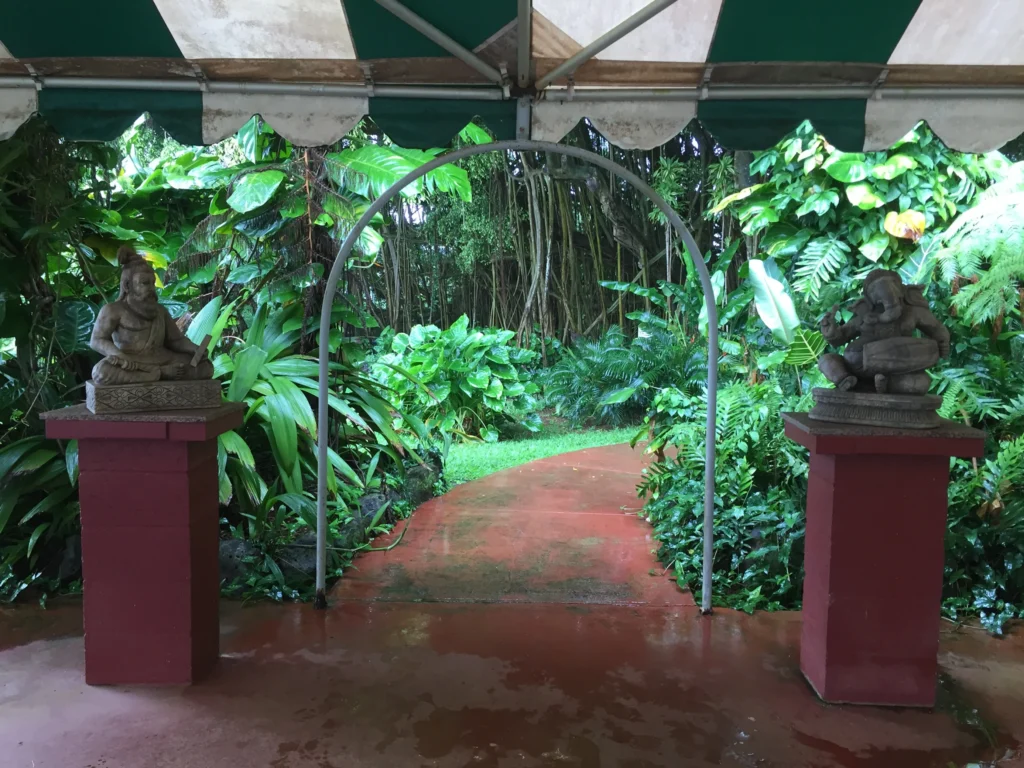
The Iraivan Hindu Siva Monastery on the Wailua River in Kapa’a is no different. It too reflects a similar vibe: the air hangs thick with years of practiced self-reflection and meditation, just as the century-old banyan tree does, straggling its genealogy in its roots. It is the monks of the monastery that President Clinton consulted when faced with national censure and the possible removal from office in the 1990s. And it is to the blessings of this timeless peace that Clinton returned when he was impeached. There is no judgement in silence. Only a large space in which the mind is allowed the freedom to think about its misgivings.

Photo Credit: Raji Writes
Learn more about the Iraivan Hindu Siva Monastery and Rudraksha Forest

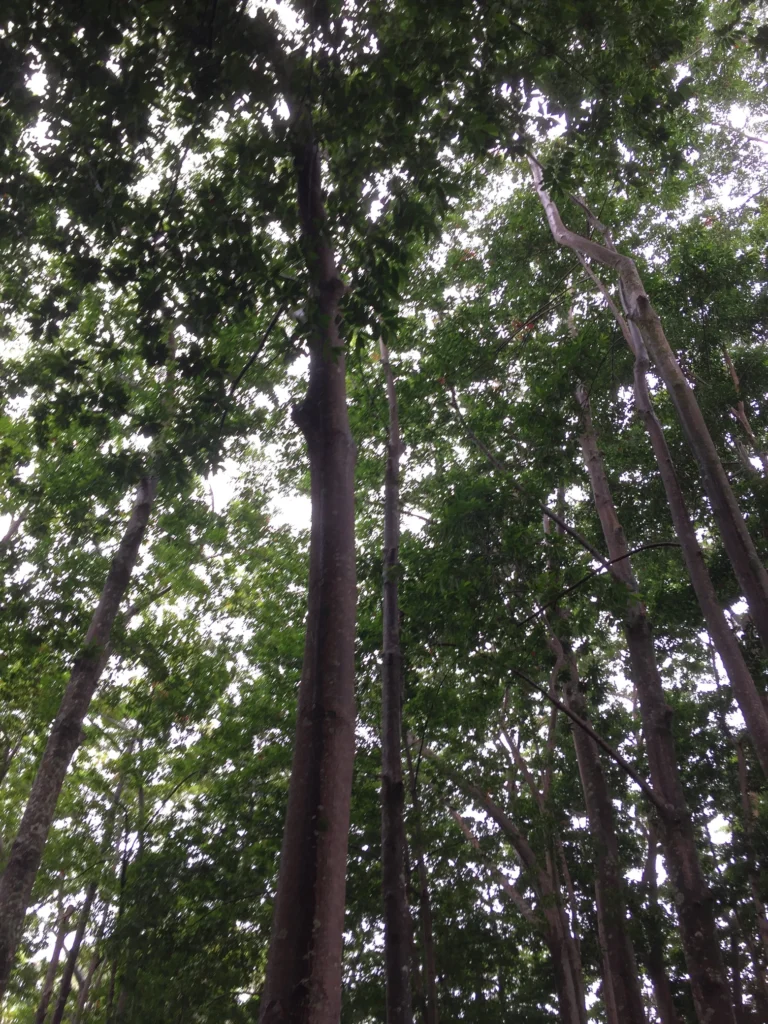
In the rudraksha forest, the only one of its kind in America, one traces the trample of footsteps deep in the undergrowth. A lot of walking has been done in these places, a lot of churning over the stuff of life to get over to the other side. People of all ages come here to get perspective—to ask the What If questions. What if things had been different? What if one had taken the path not chosen? Monks in white robes, young ones, middle-aged ones, tread softly in the forest. Visitors talk among themselves or look upward at the trees, snarling Van Gogh-like, upward into a cumulous sky. How do we find relief from the mind? How do we get across to the other side?


Photo Credit: The Hiking HI
Learn more about the Kalalau Trail

I had read Dan Ariely’s Predictably Irrational several years ago in one of my Design Thinking classes. And I remember being surprised by the recognition that all things of value are determined only in the comparison of it. That the human mind bears witness to one’s truth only in terms of relativism or comparative analysis. In comparison to Maui, say, I prefer Kauai and its absence of frenetic energy. Relative to Maui, for instance, I find it easier to still the mind in Kauai. Everything is on overdrive in Maui—but only by comparison. There, playtime and beach time are scheduled into one’s calendar while Kauai allows for the next moment to reveal itself.


Photo Credit: The Hiking HI
Learn more about the Kalalau Trail

We were in Kauai with our daughter, Priyanka, and son-in-law, Chris. Between the two of them, they had crisscrossed the entire length and breadth of the island several times over. Out hiking on the Kalalau Trail on the Napali coast, they were undeterred by the warning sign posted in clear sight: “The ground may break off without warning and you could be seriously injured or killed.” Perhaps it’s the thrill of extreme adventure or the adrenaline rush of inhaling cool, pristine air, I can’t fathom what it is, but they seem to veer toward experiences that border on the edge of nothingness. They are bent on self-discovery and they return to nature to find answers.

Out hiking on the fabled Kalalau Trail, an 11-mile stretch of difficult terrain that typifies a savage beauty, they are unafraid to bear down on Crawler’s Ledge. This is a clearing that is only 1 to 2 feet wide with sheer rock faces on one side and the crashing ocean hundreds of feet below. The Daily Beast (2019) put the number of deaths from falls off the ledge at 100 in that year alone. This is the same precipice where the nolo or black Hawaiian noddy rests comfortably, away from predators. They are all alone in the world, facing sea and surf on this impossible ledge. But they also look self-sufficient, almost pridefully so, standing apart from the whirling predators high up in the sky or close to water. In recent years, the US Park Rangers are said to have closed these trails because of the deaths of 100 swimmers who have drowned and 85 hikers who have fallen off the ledge. But the nolo is exempt from this possibility. It can fly away at will.


Photo Credit: The Hiking HI
Learn more about the Kalalau Trail

Priyanka and Chris are ultra-marathoners and long-distance bike riders. They are the sort who routinely bike 100k on weekends just for the fun of it. In Kauai, they know the easy feeders of bridle paths that veer off peoples’ backyards and gardens. They know where to go and what to do which makes them ideal guides for willing tourists. And with them, we hike. We do easy runs in Waimea Canyon, where the geography looks like a serving of raspberry ice cream, scooped atop a platter. In its verticality, Waimea Canyon resembles the Grand Canyon, except why was it that I had not heard of these Kauaian canyons before arriving here? We slip and slide on treacherous walkways, through waterfalls, on inclines that are devoid of bugs or snakes. We hear a warthog in close quarters. But strengthened with group resolve, we walk on. Foot falling, heel rising, we repeat this step a million times over.

Photo Credit: Waimea Canyon
Learn more about Waimea Canyon

I want to say that the natural beauty in Kauai is democratic. Most beaches (except for Mark Zuckerberg’s property ) are public land and open to all. The coastline stretches as far as the eye can see, all 111 miles of it, mostly available for all and sundry. Fourteen hundred acres of this coastline belongs to Zuckerberg—his $270 million home on Kauai’s sealine—but the rest of it is public. It is open to the blue-tarped shanty dwellers sleeping in the uproar of the ocean’s noise as it is to those in high-end resorts by the water. From our hotel balcony, we watch a young family of 5 making their way to the beach at sunset for five nights in a row. They carry sleeping bags and full-strength parkas, woolies, and mittens. Night after night, I see them hunkering down for the night on the beach. Around 7 in the morning, they collect their belongings and make their way back to the comfort of their hotel rooms. Later, I hear that they are protesting the existence of homelessness and the paucity of affordable homes in Hawaii. They are making their statement known, and every night, we hear of similar happenings all over the island.

What was I expecting? After all, I had been to Kauai zero times to Maui’s 8 (the number of times I had visited). We were comfortably ensconced in a roomy hotel overlooking Kanapa Beach, a natural bay where locals from Lihue paddle-boated endlessly. I watched a man paddle boat for hours on end every day. He seemed to be sorting through the chaos of his life as he crisscrossed the bay again and again. There was something repetitive and meditative about his practice, as if through this patterning, he would find a way forward, perhaps in a different direction. This lone man in a lime-green bodysuit typified for me the essence of Kauai—where at once guards with firearms block the multiple entrances of a 1000-acre property while in Hofgaard Park in Waimea, an older man with brown mottled hair lies in an open cot under a tree. We are navigating imperfections all along and as my toenail catches on skin and splatches of blood soaks through my sock, I think of this.
The Feminine Divine in Hinduism

Try as I might, I just couldn’t shake off the idea of the feminine divine. I admit that I don’t have perfect clarity on this fixation. All I knew is that there appeared to be an enormous chasm in my understanding between the godliness defining the goddess figure from the sheer hypocrisy with which she manifested in the real world. And so it was only appropriate to do due diligence by thoroughly sweeping through Kurt Behrendt, Vidya Dehejia, Devika Singh, and Stella Kramrisch. But try as I might, every attempt to figure out what the feminine divine is in Hindu life and art was met with a fog of resistance. And as if this curse was not bad enough, on the day of my presentation on the feminine divine at the Cincinnati Woman’s Club, my Word document vanished in one plop of a sound byte. It was as if it was not meant to be. It was 4:06 in the morning, and I had woken up feeling somewhat settled and composed. But that feeling withered away in a nanosecond. Everything changed. Suddenly, I was left with a blank slate in which to create a version of what I believed to be true.

This image has an empty alt attribute; its file name is IMG_8708-4.jpg
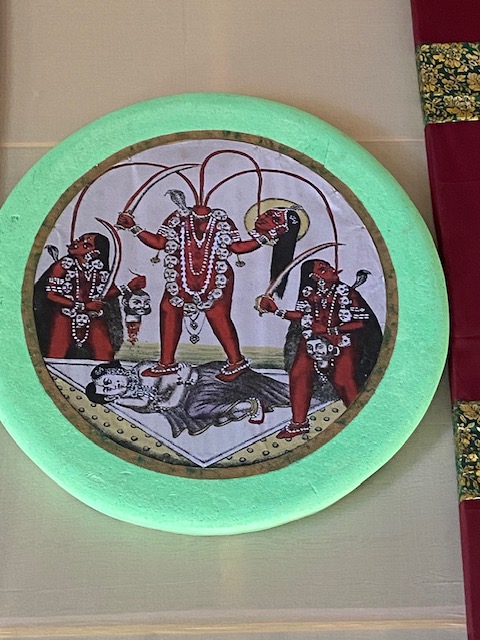
The Goddess Kali 

Skulking in the blare of my computer screen, I reconstructed word by word my ideas of the feminine divine. As I did so, I realized that my insights on the topic were juvenile at best, or compassionately stated, emerging. I knew that I had plenty of skin in the game, having been brought up in a traditional, conservative Brahmin family that was famous for abiding by the letter of the law. But the endless divide between the idea of the goddess and the practice of it in an actual setting kept confounding me. Relentlessly.

On my blank slate, I chose to become clear-eyed about all the things that I didn’t know and perhaps would never know about the feminine divine. Who was she, this goddess figure? What was her role in life and art? How did she hold a mirror to those in the living world? Was there even a place for her in our 21st-century world? And the questions continued at a tripping pace.

I don’t know if there are answers to every question that pops up in our mind or if we are meant to be in the dark about the Mysteries of Life. But that didn’t stop me from reconstructing a vision of this layered complexity where women are both revered as a goddess figure and minimized, sometimes brutally, for being who they are. She is at once a patriarchy-endorsed mother figure providing sustenance and comfort in the world. Simultaneously, she is also responsible for holding up half the sky, as Nicholas Kristof aptly noted in his study of gendered identity in the Chinese ecosystem. If our goddess figure exerts agency in the world, she is bound to come up against physical and psychological tribulations that are well beyond what is considered acceptable or reasonable. At the same time, there is enormous pressure to maintain the status quo, to let our gendered identities know their place in our homes and workplaces alike. Go figure!

Going back to the recent scholarship, Dehejia, Kramrisch, and others tell us that among God-fearing Hindus, the goddess exists as a living legend, a woman larger than life and worshipped for the ideal she represents. Still others suggest that the goddess bears a social agency in modeling how women should be. But can this drive toward the ideal triangulate into what’s real in the living world? Can this figure cohabit simultaneously the spirit world as an idea and a living world as a real thing, a woman who lives in accordance with her potential? Can she unperch herself from our living altars as an object of reverence and descend into the rough and scramble of a life lived? Can these precarious twains ever meet?

This image has an empty alt attribute; its file name is unnamed-16.jpg
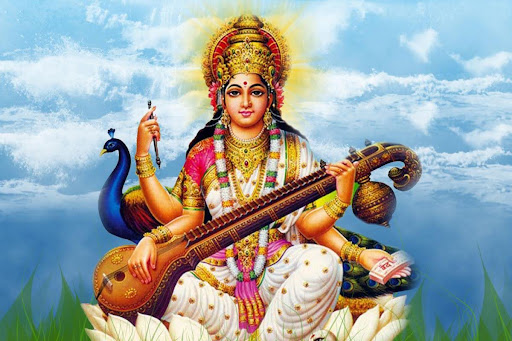
Saraswati and her swan

Judging from recent events in India, I think not. But I am getting far ahead of my story. First, I have to unpack, albeit in very broad brushstrokes, how our ideal image of divinity is forever held up in our imagination as a source of emulation and inspiration. This ideal is our gold standard, and to me, it appears as a hollow monolith that is forever locked into an ongoing fight with the reality that surrounds it.

To come to terms with all this stuff, I recounted all the things that I did know about the feminine divine. I listed, sorted, and categorized to come to a few scratchy pieces of evidence.

This image has an empty alt attribute; its file name is unnamed-2-2.png
Yakshis, 12 C.E. Chennakeshava Temple, Karnataka

I came to see that the idea of the feminine divine is as old as recorded history. When did it officially enter the canon? Who were its originators? Did any defining text, like the Quran in Islam or the Bible in Christianity—form the core of its belief system? No one knows the answers. But one does know that the idea of the feminine goddess, forming the central core of Hinduism, is likewise older than recorded history itself.

In its early stages, Hinduism seems to have placed a huge premium on the worship of the goddess. She was way more important than her male counterpart, and where the male was allowed presence, it was often as an Ardhanarishvara—a half goddess, half god figure, that existed only in collaboration. Wikipedia notes that festivals, such as Vasant Panchami, Navaratri, and Dussehra, are wholly dedicated to goddesses. The Rig Veda contains hymns composed by women such as Lopamudra and Maitreyi. Hindu epics such as the Mahabharata and Ramayana idealize women, embodied by depictions of Draupadi and Sita. It is common lore that for a Hindu to find transcendence in life, one must have visited Madurai’s Meenakshi, Kanchi’s Kamakshi, and Varanasi’s Vishwalakshmi—shrines glorifying the goddess Shakti. In these ways, Hinduism remains one of the few major religions in which women have occupied respected positions in spiritual leadership.

This image has an empty alt attribute; its file name is unnamed-7.png
Kali and Durga slay the Buffalo Demon

Through the Shilpa Shastras, we come to know that Hindu art is a highly stylized ideal and does not bear any resemblance to reality. The idea of copying—of being derivative—was the greatest skill that an artist could perfect as well as the highest compliment that they could bestow upon their master. There is little emphasis placed on being original or unique because this is not relevant to the practice. Rather, the emphasis on following tradition and adhering to its stylistic history was observed carefully and diligently. For this reason, the artist is anonymous till much later in the evolution of Indian art. And for this reason, much of the representations of the goddess follow a prescription, an ageless tradition that is known to our ancestors as they may be to our grandchildren.

The ways in which the goddess is represented are outlined in an important guide of aesthetics, the Shilpa Shastras. This text is not a standalone book; rather, it is a composite of numerous prescriptions scattered through the breadth of Indian scriptures. The Shilpa Shastras define in detail the practice of the arts and crafts, and their design rules, principles, and standards. It ranges in description from the creation of perfume and the architectural construction of a temple to the proper proportions of the human figure and the composition of dyes. The entire gamut of artistic expression as manifested in real life is to be found here.

This image has an empty alt attribute; its file name is unnamed-12-4.jpg
Detail of yogini stone carving on Konark Sun Temple, Orissa, India
This image has an empty alt attribute; its file name is unnamed-17.jpg
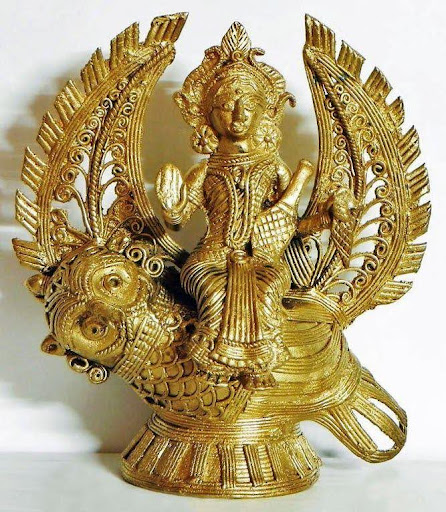
Lakshmi and her Owl

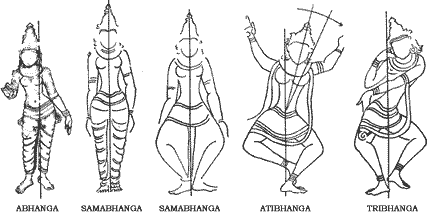
In Hindu aesthetics, the goddess gives very little away, so uniform and unreadable are her facial expressions. Rather, the gestural language of her hands and feet, her spirit animal, and her standing or seated position provide evidence of her mental landscape. What is the storyline? The defining theme of this moment in time? How is she thinking? How does this affect the trajectory of the viewer? Through an analysis of the entire picture frame, we come to know that this is her calling card. Through these stylized semaphores, she conveys information on what’s going on and how she is of relevance to us.

This image has an empty alt attribute; its file name is unnamed.gif
Standing poses

The Goddess in Worship

The feminine divine plays a central role in Hindu cosmology where she is worshipped as Shakti or the Divine Mother. G​od as a Mother Goddess is responsible for the well-being of the Universe and is considered the embodiment of incredible power.

The Hindu tradition also considers women the vessels of shakti. This identification with shakti acknowledges women as the containers of both creative and destructive power. Some feminists and scholars criticize this identification because they believe it has led society to label women either as saints or sinners, with little room for nuance in between.

This image has an empty alt attribute; its file name is unnamed-4.png
Detail of yogini stone carving on Konark Sun Temple, Orissa.


The feminine divine is at once a mother and a shrew, an annihilator as well as a giver of the life force. She is everything everywhere all at once. Her mandate is all of the above: to give hope; to uphold the powers of womanhood; to serve as an unabashed sex symbol in her clear affirmation of the beauty of the female body; to be a superpower when she wants to be one and self-effacing when she is not up to it. Her everything everywhere state of mind is reflected in the breadth, range, and scope of her being. She is comfortable being who she needs to be and in this way, she provides purpose to those around her.

This image has an empty alt attribute; its file name is unnamed-6.png
Kali steps on her husband, Shiva, after slaying the Demon

Goddesses Come in All Forms

In the Hindu pantheon, we get to choose the figure who most resonates with our inner self. Thus, goddesses come in all forms from the fair-skinned and demure Gauri, with curvaceous hips and full breasts, to the ferocious crone, Chamundi, who lives in cremation grounds with predatory animals like jackals and vultures.

Durga is the fierce warrior who rides her lion into battle at a time of crisis at the behest of the male gods. She slays the evil Buffalo Demon who is threatening to destroy the world.

This image has an empty alt attribute; its file name is unnamed-3.png
Durga in her 18-arm manifestation in a temple in Pharping, Nepal. 

When things get rough, Kali appears as the terrifying dark-skinned goddess with wild hair, blood-dripping fangs, a skirt of human arms, and a necklace of skulls. She arrives to cleanse the world of evil and to provide space for new beginnings.

Yogini or Dakini is the archetypal dangerous female associated with the darker or more wrathful manifestations of the goddess. She personifies extreme and unorthodox practices that can be terrifying. In a different time and place, women have been demonized as witches and have been burned at the stake. Perhaps this fear of yoginis reflects the cultural fears within orthodox Hindu culture of female sexuality and power.

This image has an empty alt attribute; its file name is unnamed-5.png
Yakshi adorning the Sanchi stupa in  3 BCE.

In the end, much of these ideas exist as just that: ideas. To the faithful, perhaps this is enough of a guide to see one through. In the context of 21st-century complexities surrounding the Indian woman, it may be said that India has not lived up to the Hindu ideal of gender parity and mutual respect. The country is deeply entrenched in patriarchal sometimes archaic norms where women are largely unseen, unheard, and unacknowledged. Often, her efforts at autonomy do not end well. All of this can be contextualized with the disclaimer that among the educated, the Indian woman is generally recognized for who she is. Among the vast population of the illiterate, neanderthal ideas still run deep. Change comes very slowly if at all.

In the end, the conundrum continues to baffle ordinary folks like me. What is the value of an idea, I ask myself? Can perfection be achieved or sustained in the material world? Is the opposite of reality, another reality, that is humanly off-limits to our understanding of things? 

New York City in the Summer

New York in the summer is a sure recipe for heartache. There is something in the air, a fragrance wafting from the direction of Carl Schurz Park, say, that makes you stop and look around. The city feels new as if it has undergone an exfoliation of dermis and epidermis. Old skin has been ceremoniously removed. A rebirthing is in process. The leaves are freshly minted, the horses high-footed in their clip-clopping around the city streets, the air is thick with expectation.

Am I the typical tourist who is awe-struck by New York? Not so. In fact, this is the city of my initiation into American life. It is the city where I found a rebirthing when I arrived here as an international student in 1980. This is where my life began again and this is where I grew to be the person I am. For this reason, I love New York in all its avatars—its paranoid misgivings, its energy, its artistry, its chaos, its wild and feral beauty. But after spending much of my adult life in the American Midwest, I find myself yearning for the dullness of routine, the surefootedness of predictability. I can only take New York City in spurts any more, knowing that I can flee its electric energy and return to the quiet of my Midwestern existence at any given time. Even so, I visit the City several times a year, so gripping is its magnetic overreach to us in the faraway hinterlands.

Olivia Laing wrote that New York is perhaps one of the loneliest cities on the planet. And this is evident in the faces of people walking by, their faces monolithic in their isolation, their eyes dulled into automatic by the lack of human connection. Edward Hopper got this alienation spot on, of people staring out of windows into a teeming landscape but seemingly focusing nowhere, remaining all alone in the world.

This time around, I am staying in New York for a full two weeks. I tell myself that I want to feel like a certified New Yorker, on first-name basis with Johanna at the local bakery between First and York. I want to befriend our local laundress, Mrs. Ma, who is impressed with my beginning Cantonese. I want to get to know the local UPS storekeepers, the Tal-ben Bagel shopwallahs, the Italian, Lebanese, and Honduran eateries all within a few blocks of the other. I want to know my Bangladeshi fruit seller who plays lesser-known Johnny Cash songs on a radio hung on a clothesline. The lucky ones who successfully guess that sooty, coal-like voice, gets to take home a free fruit. I want to know my neighbors from Mt. Sinai and Sloan Kettering, their stories, how they got here, what they have made of their lives. And it is this search for connection that keeps my mind from becoming lost in my own wanderings.

In my aimless wanderings in the City, I find my people not only in the alive company of our adult children, whom we visit by dusk. But by day, I turn to the faces lining the walls of city museums. Each time in New York, I go to the Met (only a few blocks away from our pied-a-terre) and MoMA, and then I add on one more with each visit: the Museum of the City of New York, the Tenement Museum, the Frick, the Guggenheim, the Whitney Museum of American Art, the Museum of the Moving Image, the 9/11 Memorial and Museum, the Ford Foundation, Asia Society, P.S. 1, the Brooklyn Museum, galleries in Tribeca and Soho and Chelsea, and the list goes on. The offerings are so plentiful that one could spend an entire lifetime here and only get to know New York as a speck on a pointillist canvas.

Today, I have come to the Met to get to know some humans in whom I’ve had a passing fancy. Once within the museum walls, I strategize my reach. I will meet two individuals in half an hour and I will get to know them best I can. Speed-dating you may call it, and this works for me as an antidote to my loneliness. These are the characters who are so entirely memorable in how they present themselves that they have become alive to me. They define not only their times but also an ageless present in which I feel recognized.

I first meet Bronzino’s Young Man created in the 1530s. He is by far one of the prettiest boys that I have seen, serving as an advertisement for material excesses of the most opulent kind. Gorgeous architectural details in his background speak to his class and the wealth—which as we can see, he enjoys immensely. He stands lord and master of his domain by mansplaining in clear sight. His slender fingers—not used to manual effort of any kind—appears boneless, it hangs loose like a piece of elastic, dipping into not one but two place-settings in a book that he has on view. This gorgeous piece of eye candy not only possesses physical prowess, but he also has intellectual might. His other hand deftly assumes the quintessential Renaissance pose—his elbow breaking through planes of reality and jutting into the viewer’s space—showing that he has the authority to do just that.

Our young man’s clothes could be right out of the pages of a Bergdorf catalog. Akin to the likeness of 21st-century acid-washed jeans, this young man’s clothes are distressed by volition. The satin threads running through his shirt are intentionally plucked out to give it a splintered, carelessly shabby look. The fact of a perfectly styled expensive piece of couture being defaced (somewhat) speaks to the wealth of this individual: he has the money to look like the common person (sort of) while living in the excess of haute couture. He has arrived and he knows it.

Bronzino (Agnolo di Cosimo di Mariano), Young Man, 

1530s, Metropolitan Museum of Art

This air of supreme contentment typifies sprezzatura, a feeling of high confidence, of being in grace under pressure. Our young man’s gaze holds the viewer steadily with one eye, while the other eye—a lazy one to behold—surveys the landscape to assess what dangers may lurk in the background. I wonder if this is indeed a physiological aberration or a psychological one, meant to unnerve the viewer so that they question the ground on which they stand. One thing is clear though: the viewer could never be on par with our young man here. There is so much to notice here. Is it ever possible to know another?

I keep wandering the galleries and come to the next person who calls my name. I see a young girl looking straight into my eyes. She is Mäda Primavesi, who lived during 1903-2000, and whose portrait was painted by Gustav Klimt in 1912-13. Mäda was barely nine years old when she was painted but her confidence and deportment belie her age. Where Bronzino’s young man is a picture of ideal beauty, Klimt’s Mäda is a real person. Her young but mature face looks just like her, as is evidenced by the photographs of Mäda that remain.

Gustav Klimt, Portrait of Mada Primavesi, 1912, Metropolitan Museum of Art

Prior to her death in 2000, Mäda visited the Met regularly and spent hours looking at her portrait—one that was commissioned by her industrialist father and her progressive mother. Both parents were known for hosting decadent salon-like gatherings at their country home and supporting the community of artists and architects called the Wiener Werkstätte. They were undoubtedly familiar with Klimt and his contemporaries.

Leading up to the years of the Second World War, the Primavesi family lost everything: their stature, their sense of belonging, their peace of mind. Mäda’s portrait was seized by the Nazis in 1938 but fortunately returned to the Pulitzer Steiner family in 1951. In 1964, it came to the Met by way of a gift of the Pulitzer Steiner children.

In terms of how the painting came to be, Otto—Mäda’s father—commissioned the seven-foot portrait as Klimt’s only major work featuring a child. To prepare, Klimt created numerous studies of Mäda perched atop a chair or leaning forward. The pose that made it to the final frame involves the girl staring directly at the artist, her legs firmly parted, completing a perfect triangle in the shape of her stance. Her arms hang behind her back, almost defiantly. Here is another sprezzatura moment highlighting the sitter’s extreme confidence. She will not be phased and she is here to tell you so.  In the portrait, Mäda is standing tall in a white dress surrounded by a sea of color and pattern. The picture testifies to the sophisticated taste of her parents, and the hand of designer Emily Flogge who was a master of color and floral prints.

How is it ever possible to be alone in the City when so many interesting characters exist in plain sight? So many stories are waiting to be told. So many insights await to make us come alive in the moment. As Gustav Klimt noted, we can often know the painter (or writer) through their work. If you are looking for a connection, look no further than in your immediate line of view.

“Whoever wants to know something about me… should look attentively at my paintings and there seek to recognize what I am and what I want.” Gustav Klimt

All Photos are Courtesy of Amy Karlen, New York City