Loading...

Casa Mollino in Turin, Italy

“Humans matter only insomuch as they contribute to a historic process; outside of history, humans are nothing.” ~ Carlo Mollino

It is foggy outside, not the thin mist that simulates marine haze but the denser variety where visibility tends to destabilize objects, preventing them from ever coming into focus. And so it is today. We have made the 2-hour drive from Milano to Turino in Italy, a drive of 150 kms. Our bus driver is a cross-tempered, mean-mouthed young man who has long threatening harangues in Italian on his phone. We understand very little except the essence of it all. Either he seems to be leaving someone or he is fighting this outcome in the most desperate ways. But we are the sorry victims of his darkness. On the bus, all sixteen of us careen from one side of our seat to another even with our seatbelts buckled. We brace, we feel broadsided, we are squarely in the crosshairs of a relationship gone bad. At once I feel that we are living on the edge of a vast energy field, a limitless ocean of emotional and mental turmoil that is impossible to fathom. These thoughts persist as we pull into Turin around 11 a.m.

The view of River Po outside Casa Mollino–Photo courtesy of Judy Stein

I am still fighting off the wine from last night’s dinner at Il Capestrano, a fancy restaurant in Milan specializing in the cuisine of Abruzzo. Our long-time friend and guide extraordinaire, Judy, has meticulously planned every aspect of our trip to view design and art in Milan. She has a sixth sense about things, curating every part of our 8-day adventure so that each one of us will have our deepest desires met. I don’t quite know it but today, at the Casa Mollino in Turin, Judy will have made sure that my insatiable thirst will be quenched, if for a minute. For the longest time, I’ve had an uncanny fascination with Carlo Mollino, an eclectic architect and designer who saw the world in broad swaths of connectedness. I’ve wanted to know him better. And in his apartment in Casa Mollino, under the tutelage of the curator, Napoleone Ferrari, I am about to receive a thorough grounding on who Carlo Mollino was and what he left behind. 

1888 Villa Avondo—the street address of Casa Mollino–hides behind brambly rose bushes past a wrought-iron gate on a half-forgotten side street. Mollino owned three such apartments all over Turin—places where he could indulge his creative interests away from his controlling father. Casa Mollino was his escape room, the one spot that he endlessly worked on but hardly ever used and never quite lived in. This is the Warrior’s House of Rest that Mollino conceived as his final resting place. Like the ancient Egyptians whom he undoubtedly studied at the nearby Egyptian Museum, Mollino spent eight years preparing this house like an ancient tomb, filling it with everything that he thought he might need in the afterworld. He decorated the interior, remodeled furniture for the space, fashioned the wall coverings and mirror etchings, designed the photographic displays, and even hand-crafted an oval-shaped bed that resembled the Egyptian skiffs that ferried the dead into the afterlife. Mollino believed that the Egyptians had perfected the art of dying by preparing for their death for much of their life. Outside, the River Po flowed by, his Egyptian-influenced burial chamber overlooking the river of life. A desolate looking ankh—which opens the mouth through which the soul escapes the body—lay in wait on the apartment’s windowsill.

The gate leading to Casa Mollino

Interestingly, Mollino completed the interior of Casa Mollino and the design of the Regio Opera House and the Turin Chamber of Commerce at the same time. They are so markedly different one from the other that it seems that at least two different architects have designed them. In fact, Mollino considered architecture “a linguistic system that combined different styles and building techniques as a vocabulary to draw on” according to Ferrari. He drew on this extensive vocabulary to complete the final projects in the last decade of his life, 1960-73.

A Mollino-designed chair meant to hold erect a seated figure

In life, Mollino developed himself to his fullest capacity.  An architect; sportsman; cultural historian; designer of motor cars, haute couture, furniture, interiors, and erotica; a photographer; writer of novels and an autobiography; a skier; acrobatic flight instructor; and a professor of architecture at the Polytechnic of Turin from 1949 to his death in 1973, Mollino more faithfully resembled a Renaissance polymath than an Egyptian royal aspiring for the afterlife.

The oval burial bed resembling an Egyptian skiff

Mollino, who was born, lived and died in Turin (1905-73), cultivated an everything, everywhere, all at once type of outlook. He was born in this famous city known for housing Jesus’ shroud and lived in the 19th century neo-Gothic Casa Rivoli. An only child born into a wealthy family overrun by women, he was pampered by his mother, great aunts, and housekeepers. His father, Eugenio, provided the controls in his life. A strict disciplinarian and a renowned architect, Eugenio had 300 architectural buildings to Carlo’s 13. And this is what Carlo ultimately took away from his parents—Eugenio’s passion and rigor for architectural and foundational brilliance and his mother, Jolanda’s, ability for nurturing and spontaneous exploration.  

Curator Napoleone Ferrari showing us a photo of Carlo Mollino–Photo courtesy of Judy Stein

Stylistically, he fancied himself a Surrealist trending toward his own definition of a Modernist. He was one of the first to have arrived at a definition of what contemporary art meant. He meticulously formulated his ideas on the interconnectedness of all life, noticing the arabesque whiplashes of Art Nouvaeu paintings mirrored in the wide-open sinuous S’s of a skier forming patterns as he glided down hillsides. Or an aeronautical stunt pilot figure-skating in the skies. Beginning with the marble of the fireplace to the designs on the windowpanes, fabric designs of the recliners to the reflected images in multiple mirrors set up for self-reflexiveness, he left nothing to chance.

Lighting fixtures designed by Mollino

Taking nature as a source for both engineering and creative energy, Mollino synthesized. He interconnected, filled in the blanks, and formed a coherent universe that was hardly apparent to those with limited imagination. Even as he was creating, he was hypothesizing, theorizing, drawing out generalizations from the evidence that was provided for him. His 50,000 paged archival holdings at the University of Turin formulates detailed drawings on everything:  the scale and proportion of ski lifts and backless dresses, the seat of an ample chair resembling the fleshy buttocks of a seated woman, and stunts for airplanes that twisted past hairpin bends and death-defying turns. He fashioned race cars after turbines that referenced the bombs that fell during the blitz. Ultimately, he was interested in mirror images, of silhouettes repeating themselves, in how energies converged or diverged. His imprimatur was lightness and dynamism, of the quickness of joy and the swift movement of the passage of time. 

Kitchen tiles crafted by Mollino–Photo courtesy of Judy Stein

When we leave Napoleone Ferrari’s curated tour of the Casa Mollino, we are in tears. Napoleone is crying silently because Carlo has not received the recognition that he so richly deserves. Some of us are crying because we are humbled by the genius of a man who worked quietly to make the world a better place for all.

Mollino’s hairbrush on the windowsill–a nostalgic memento of the person no longer here

Antarctica: the White Continent

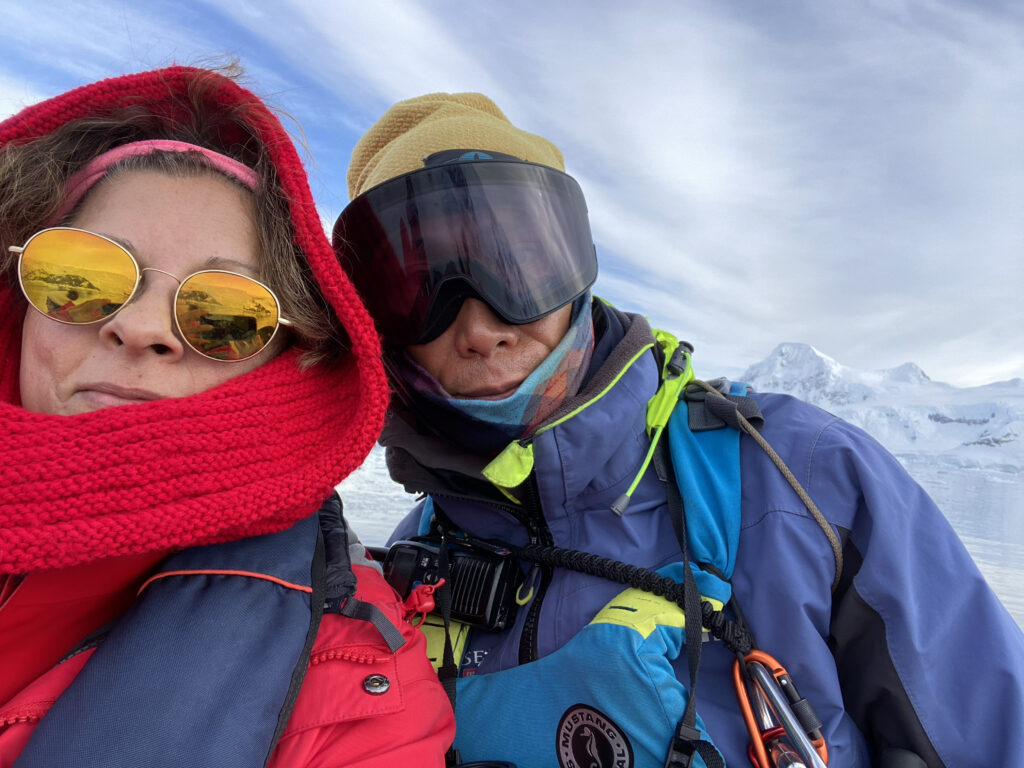
Only the fearless come to Antarctica. Our historian from Johns Hopkins University, Richard, tells us that at last count, only .002 percent of the world has visited Antarctica, ever. I imagine a barren, brutal landscape standing brilliantly at the bottom of the world. But what I see defies imagination. Antarctica is not only teeming with the possibilities of life, but it is thick with the fatness of the continent itself: a rich cornucopia of creation which is marked by human absence. Our research crew on the 200-passenger expedition ship, Silversea’s Cloud, carries us over the dreaded Drake Passage and into the mainland of Antarctica. Today, the Drake Passage is calm, and we pass effortlessly through it. We are not going as far as the Ross Sea and the McMurdo Research Center, which is truly at the bottom of the world. We are sailing the Weddell Sea across the Gerlasch Straits and into various points of the Antarctica Peninsula, a route that Shackleton himself crisscrossed more than a hundred years ago. Our route is not intended as a facsimile of Shackleton’s journey on the Endurance; we are firmly on the path of our expedition ship.

With CK, our passionate educator from Hong Kong

On board are a fierce group of marine biologists, historians, glaciologists, ethnographers and cartographers, artists, hydrologists, meteorologists, cetologists (those who study whales, dolphins, and porpoises), acousticians. They form a ruthless band of dreamers, a group of people who will give up everything that they own to travel the world and learn from its abundance. CK, for instance, is a Mandarin-speaking fiery lightning rod. Once centered in the fashion industry of Hong Kong, now he spends his life in the wilderness: summers in the Southern hemisphere in Antarctica, and summers in the Northern hemisphere in the northern most Arctic regions of the world. These are the dedicated dreamers, the full-time, all-in kind of wanderers who believe so much in the sanctity of our planet that they will unravel the fundamental design of their lives to live close to the earth. Global warming is real, CK tells me, his eyes over-flowing with tears. Unless we do something in our world, we will not exist any longer.  As if this is not a death warning enough, he tells me that if all the icebergs in Antarctica were to melt, sea levels would rise over 180 feet. Human extinction is almost assured, he reiterates, looking at us intently to make sure that we have heard.

where land and sky and water meet…

The sentiment is jolting but in this brutally pristine landscape of Antarctica, it arrives with an uncommon expediency, an unnerving cadence. We are not professional dreamers, just the weekend variety. The ringleader of the group is perhaps me, an established wanderer of sorts.  Smitten by wanderlust from a very young age, I have a desire to travel to unknown destinations, to feel the world in my hair and to talk to complete strangers about what matters most to them. For this trip to the 7th, I’ve gathered a motley crew of my husband, Shekhar; my sister, Oli; and our friends Natasha, Debjani and Karno—who enliven our days with energetic mother-son repartee. We have come here with hopes of embarking on a pilgrimage. But we find the experience way more immersive, exploring land and ocean for up to six hours a day in -8 degree temperature. In the afternoon, we sit shoulder to shoulder–students in an auditorium– and diligently take notes. The lectures are grounded in experience and take us to unknown ideas. On this continent, we are experiencing first-hand the overwhelming recognition that we have never been in control of our universe, only of our own responses to it.   

Exploring the Gerlasch Straits

There are multiple entry points into Antarctica and each one of them merits at least a book. I ponder these ideas as I feel my presence/absence in this vast continent. I could engage with Antarctica by noting its diversity as the veritable United Nations of the world, owned by no one country, but its resources protected by the United States, the UK, Chile, Argentina, Norway, France, New Zealand. I could talk about how 98% of the continent is uninhabitable and largely unexplored. Or how the bird population—albatross, petrel, skuas. sheathbills– are distributed along cosmopolitan principles—or in diverse communities and societies, just like humans. How penguins have a strong site fidelity—or the tendency to return to their homes no matter what calls to them. How birds use stars and the magnetic force of the world to determine their GPS. How the sound of icebergs cracking at their joints match in intensity the sound of male whales, which can be heard from almost 60 nautical miles away according to Dr. Roger Payne‘s haunting recording, Songs of the Humpback Whale(1970). How icebergs are glaciers that have broken away and are made of pure water from 15,000 years ago. How Robert Falcon Scott and Ernest Shackleton both had a common competitor in Roald Amundsen, who made it to the South Pole first. How the highly successful Antarctic Biennale of 2017 effectively brought together artists from all over the world to explore the artistry that is inherent in the science of the White Continent. 

Taking care of the home and hearth

In preparation for Antarctica, I read Alfred Lansing’s brilliant recounting of Shackleton’s story, Endurance (1959). Lansing spent a lifetime meticulously researching and imaginatively putting himself in Shackleton’s shoes. I noticed Lansing’s deep compassion for his subject as well as his imaginative over-reach in describing every battery, every misfortune that Shackleton and his men experienced on the high seas. Spoiler alert: the real-life exploration reads like a nail biter. Shackleton and his 27-member crew, each person chosen intentionally and a stowaway, voyaged to the end of the world in the hope of setting a record. They were thwarted from their goal by less than 100 miles when their ship, Endurance, became mired in ice floes and eventually sank. Shackleton and his men were able to retreat and landed on Elephant Island, named for the elephant seals that bask on solid ice. While Shackleton and five others went for help, 22 men lived on this open spit for more than 18 months between 1915-1917. It is a testimony to Shackleton’s greatness that he made it back to rescue his men and return to England with everyone accounted for. While Amundsen holds the record for being the first to the South Pole, Sir Ernest Shackleton’s story remains larger than life in the public imagination. Lansing’s account, which studies Shackleton’s persona, his leadership style, his planned and unplanned expeditions through those years between 1915 and early 1917 is a must-read for those wanting to experience Antarctica.  In fact, it’s on Shackleton’s account that Antarctica gets situated so dominantly in the public imagination in our time. 

The artistry of the White Continent

Like Shackleton, I see that the scope and scale of this 7th continent are almost incomprehensible. The defining themes that help me get a sense of the place are….

Looking at the world go by

Time

Time is timeless here. Being in the Antarctic for a good ten days, I became enveloped in the sounds of stillness. Everything stood massively, monumentally, as if time had chosen to express its timelessness by standing still in real, temporal time. Seeing nature stand, I too followed along and practiced folding into my own silence until I could barely hear my own heartbeat. 

I witnessed paleologic time, of time deeply embedded in the underwater volcanoes and icebergs—a time that is deep and vast and reveals the biogeography of creation. This stands in contrast to temporal time—of time that belongs to a human life and which can be measured in cycles, seasons, phases, months and years. And unsure about how to focus on the shifting gauge between the finite and the endless, I became exclusively aware of the present moment. Nothing mattered except the sheer now, requiring a massive mind dump of past and future time.  

Light

In Antarctica, summer daylight persists like an unwelcome guest for 24 hours. The sun never sets although the light does a soft fadeout for a couple of hours every day.  Most other times, the light is in full focus as it spotlights, mirrors, reflects, and refracts everything in sight.  The light is sharp and piercing, reflecting the whiteness of land, refracting the double and triple image of sky in land and in water, so that the landscape from one’s window looks like a giant kaleidoscope. There is nothing to do except to immerse one’s self in the rawness of this beauty.

the 24-hour long days…

Absence of human presence 

In this landscape, the presence of humans is completely absent. For this reason alone, perhaps the 7th is the last bastion of unspoiled nature, of an ecosystem devoid of human intervention. To become more attuned to sustainable practices, we were schooled in these ways of living:

  • Attend a lecture (or read a book or listen to a podcast) on how to leave a smaller footprint on the planet;
  • Shower for five minutes less every day;
  • Write reflectively;
  • Switch off lights when you leave a room;
  • Take as much food on your plate as you will eat—don’t waste food;
  • Become community-centered and less reliant on your car.
The emperor of the oceans

In the end, Antarctica left me with an urgent need to do practical things in the real world, action items that will privilege my comfort less and the planet, more. Science tells us that we are clearly at a tipping point. Unless we change our ways, we will most certainly lead to our own extinction. This is the only occasion—in real time—when we can reverse the narrative. We can choose how to respond to our world now or never. And then we will have to forever hold our peace.

(Some photos courtesy of fellow travelers not seeking acknowledgment for their work.)

Setting out for India: October 2023

We’ve been up all night, trying to ignore the thud thud thud of wetted newspaper balls ricocheting off our Over the Rhine (OTR) windows in Cincinnati. We have a whole bank of windows and we let in the light even when it is inconvenient. To feed our idiosyncrasy, we leave the shades up all night. This is FOMO in real time, giving us unobstructed views of our newly-discovered cityscape–where people come and go at all hours of the day and night. We have committed to living in our sun-drenched OTR apartment for half a year in between the sale of our Frank Lloyd Wright-inspired home in pastoral Indian Hill and the remodeling of our condo in urban East Walnut Hills. But this is getting far ahead of our story. 

I want to say that everything is connected, sometimes, willy nilly. Even when things don’t seem to add up, in some faraway place and time, they do, shazaam, and one is left wondering how one might have missed the connectors in the first place. 

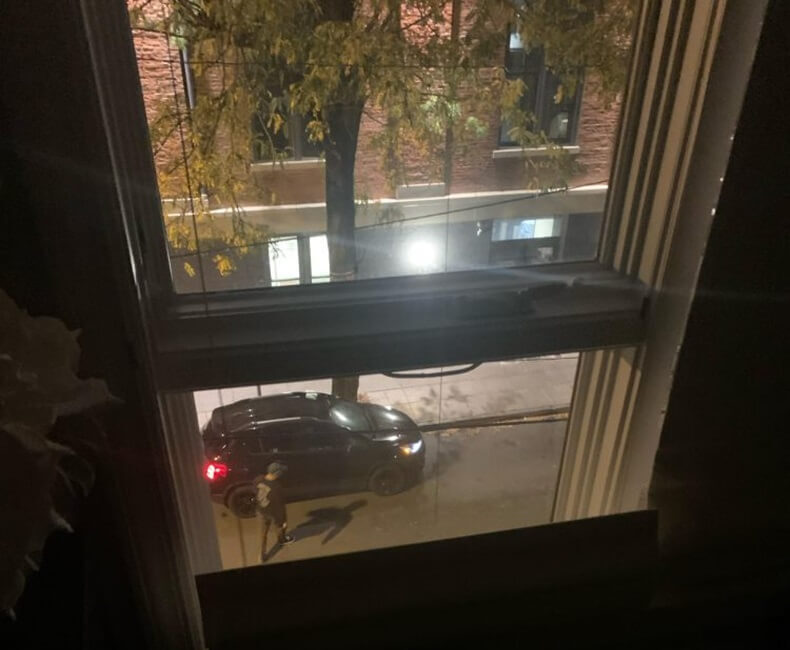
So, just past Taft Brewery on the way to the FC Cincinnati football stadium, we see two young men in a black, 4-door sedan, in their early 30s, Caucasian, wearing baseball hats, one with scruffy facial hair and the other clean shaven, dark sweatshirts and khakis. They are dressed alike not unlike typical Ohio kids of a certain socioeconomic strata. Ohio parents tend to dress their Ohio kids alike when they are growing up. So when the District 1 police shows up six hours later, the identifiers are convenient beyond reason, a pass given to us without the asking. We have observed these two since 12.30 a.m. and we have begun to construct a narrative of who they are. They are baseball-bat wielding angry young men who hide their firearms under their sweats? Or ax murderers avenging past vendettas? After all, they’ve been watching us through our open window and have begun to build their own case history of who we may be. We live out our story all night long, looking through tiny portholes in the slats of the window shades, now pulled down for partial anonymity. 

A view from Apartment 203

But fast backward and it is just after midnight. We are padding around like swaddled babies in our billowy jammies. We are just back from the Cincinnati Durga Puja, a celebration of the goddess force that draws a thousand people from all over the Tri-State area of Ohio, Kentucky and Indiana. Returning past midnight in Over the Rhine is a no-no, and it doesn’t help that I look like a lit-up, Dan Flavin neon sign in my richly embroidered teal Benarasi silk sari. I am wearing gold and filigreed jewelry called kundan which is worn particularly during auspicious celebrations. 

Somewhere, through an open window we hear a raspy woman’s voice breaking the night quiet, “Sir, will you stop ringing my bell. I am not expecting anyone at this hour.” The whole experience is surreal—the goddess, midnight in the OTR, two young men in a black sedan, how does the calculus tally. 

This is when we decide that’s its safest to go to bed. In a few hours, we must rise for our journey to New York and London and New Delhi and Kolkata (formerly Calcutta). This is the season of Dussehra and Durga Puja and it is the Super Bowl of all Indian festivals. Dussehra is to Indians and Hindus what Christmas and Eid-al-Fitr and Hanukkah are to the monotheistic religions of the world. We are traveling to our family home in Kolkata to witness the festivities and not having seen it for many decades, our excitement is close to electric. 

So when the alarm goes off at 6.30 a.m. and our lights switch on, we smile. But the familiar refrain of thud thud thud is disquieting. This time, the taillights of the black car are on. A couple of honks and then an yell in acknowledgment of our burning light: “For God’s sake, will you let us in?” And this is when the District 1 Police is summoned. Suspense follows, hearts palpitate, finally, the results come beeping in: license plate-check, license numbers–check, storyline–check. The youngish police officer tells us that we can let these fools into the house if we wish. These are in fact salt-of-the-earth Canadians driving into Cincinnati for the Sunday afternoon Bengals-Seahawks football game. They are weekend lodgers in # 201 next door. In their excitement to hit town the night before, they broke their key in half and, of course, it is only reasonable to question why they would carry their phones with them when they could very easily leave them for safekeeping in their AirBnB rental. 

We let them in the front door and the story should have ended there…but what I want to say is that the foolish wanderings of two young men about town was hugely inconvenient for me. Singlehandedly, they made me forget my tidy bag of jewelry — my favorite earrings, my pearls, my gold bangles. Thus, I missed every future opportunity to look glamorous during the Pujas in Kolkata. It was my turn to shower inglorious blame on these guys for all the inconvenience that they caused me.

Anu and her friend, Chandni, at the Tri-State Durga Puja in Cincinnati, October 14, 2023.

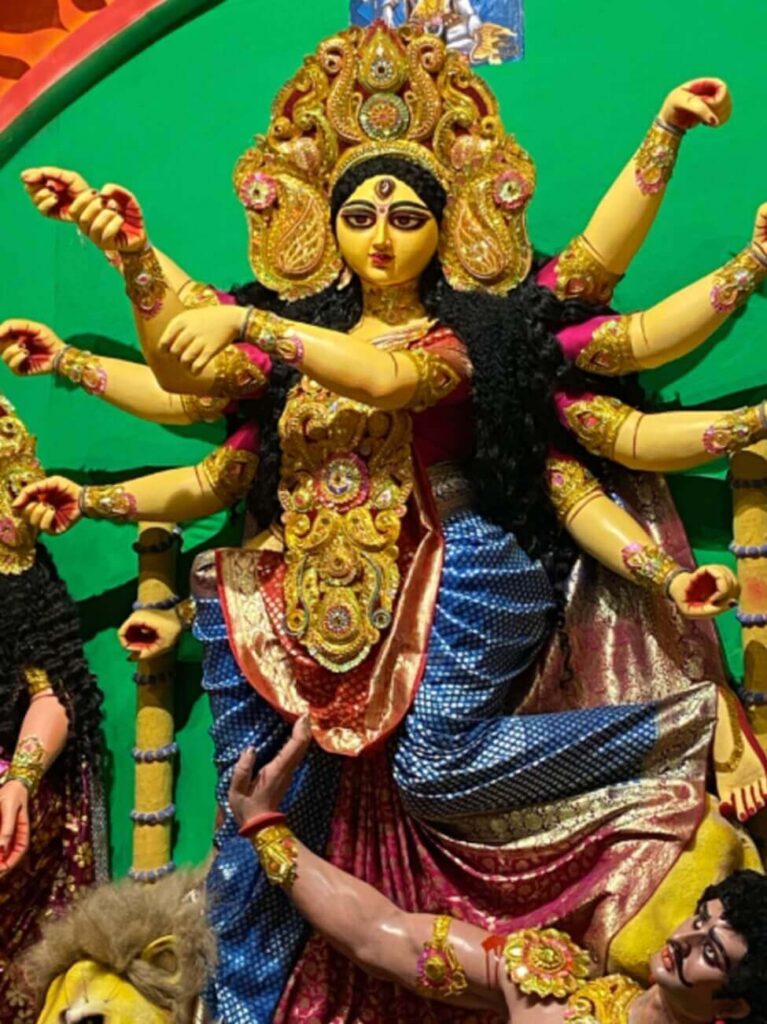
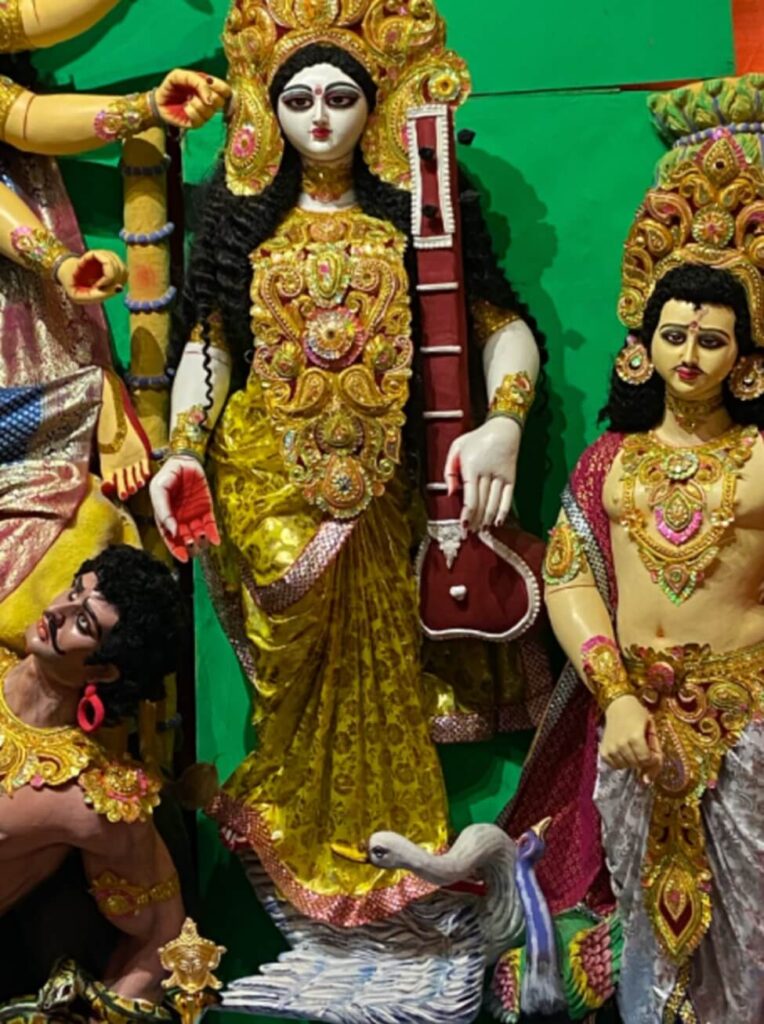
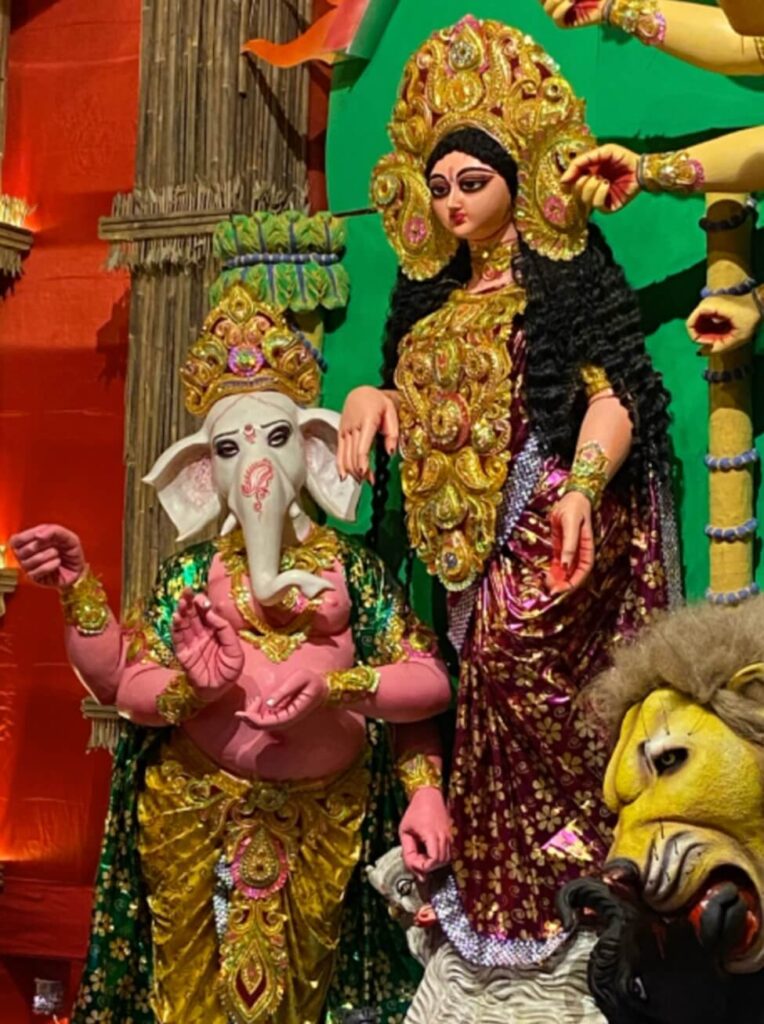
Dussehra and Durga Puja were observed in late October 2023. This is when Durga, the consort of Shiva, comes down to earth on her annual visit, to cleanse the world of all its evils. This she does symbolically by overwhelming the demon buffalo Mahishasura. Durga, along with her four children, reminds us of the daily goodness that surrounds us. Her four children are a constant presence in the lives of all Hindus: Ganesha, the elephant-headed god, removes all obstacles in our path; Lakshmi, the goddess of wealth, showers us with emotional, material and intellectual riches; Saraswati, the holder of all knowledge and wisdom, grants us understanding; and Kartika, the god who represents the balance of beauty in body and soul, keeps us whole. Every year, Durga reminds us that goodness conquers evil and this simple faith sustains us through the year.

Durga with her 10-arms symbolizing that a woman’s work is never done!

Since 2021, UNESCO has named Kolkata and its season of Durga Puja as a World Heritage Site. As a result, the Pujas have exploded in artistic ingenuity and brilliance. 

It is almost impossible to recognize our daily sources of abundance when war rages in the Middle East and lays bare the lives of thousands of innocents. Human beings suffer viciously all over the world. But in all of this, I am given the quiet reminder that it is risky business to confront the unknown. It goes against our grain to let in strangers in the dark. But if we are brave enough to do so, our ‘enemies’ can become new friends with a history. Sometimes, this understanding is given to us on our own doorstep. And it is handed to us on a platter within our very grasp.